The rep knocked 60 doors yesterday and booked zero appointments. His manager reviewed the recordings, confused. The rep said everything right—perfect opener, textbook objection handling, flawless value proposition.
So why wasn't it working?
I watched the first five interactions. Within 90 seconds, I identified the problem. His words were perfect. Everything else was wrong. Body language screaming "salesperson." Vocal tone conveying desperation. Physical positioning that felt invasive.
Homeowners weren't rejecting his pitch. They rejected him before he started pitching.
After training over 1,000 roofing sales reps, I've learned that what you say matters far less than the psychological patterns you trigger in the first three seconds. The best script in the world fails if homeowners categorize you as "threat" before conscious thought even engages.
Understanding this psychology separates reps booking 18-25% from those knocking hundreds of doors for nothing.
What Happens in the First 3 Seconds
When a homeowner opens their door to find a stranger on their porch, their brain executes a specific sequence before words matter.
Within 0.5 seconds, the amygdala scans for immediate threat. Is this person dangerous? This happens unconsciously, before rational thought engages. The brain categorizes the stranger into known patterns—delivery driver, neighbor, or door-to-door salesperson. This categorization determines which psychological defenses activate.
If homeowners' brains tag you as "salesperson," specific barriers activate automatically. Their internal dialogue shifts to "how do I end this interaction quickly?" They're not evaluating your offer. They're executing a learned script that's worked hundreds of times: polite rejection makes salespeople leave.
Research from Psychology Today on first impressions shows people form initial judgments within 100 milliseconds, and these impressions predict final outcomes with 90% accuracy. By the time you say "Hi," homeowners have already decided whether to engage or dismiss.
Reps booking appointments consistently understand this. They don't obsess over scripts. They manage the psychological patterns they trigger before words begin.
The psychology of instant categorization: Homeowners make three critical assessments in under three seconds—threat evaluation (0-0.5 sec), pattern categorization (0.5-1 sec), and engagement decision (1-3 sec). Once they've categorized you as "salesperson," psychological barriers activate automatically, making everything you say afterward work uphill against resistance that formed before you spoke.
Why Perfect Scripts Fail: You're Triggering the Wrong Psychology
Most door knocking training obsesses over words. Practice your opener. Memorize objection responses. Perfect your value proposition. This completely misses how human psychology works.
Homeowners don't consciously evaluate your words and make logical decisions. They make unconscious psychological assessments that determine whether they're willing to engage, and those assessments happen before your pitch begins.
When you approach doors with typical salesperson energy, you activate specific defenses. Reactance kicks in when homeowners feel someone is trying to influence them—they instinctively resist to maintain autonomy. Your clear intention to get them to book an appointment triggers this protection against manipulation.
Cognitive load overwhelms them when you explain insurance claims, storm damage, inspection processes, and contractor qualifications in the first minute. Their brains default to the easiest decision when overwhelmed: no. Loss aversion triggers anxiety when you emphasize additional damage, worsening conditions, and insurance deadlines. You're trying to create urgency. You're actually triggering fear that results in avoidance.
These responses are automatic. Homeowners aren't choosing to be difficult. Their brains execute defensive patterns designed to protect them from manipulation and overwhelm.
The reps booking appointments at 20%+ rates leverage different psychology—creating openness instead of defensiveness.
The Body Language That Overrides Your Words
Your nonverbal communication has more psychological impact than anything you say. Homeowners make trust assessments based on cues they're not consciously aware they're processing. Perfect words mean nothing if your body language contradicts them.
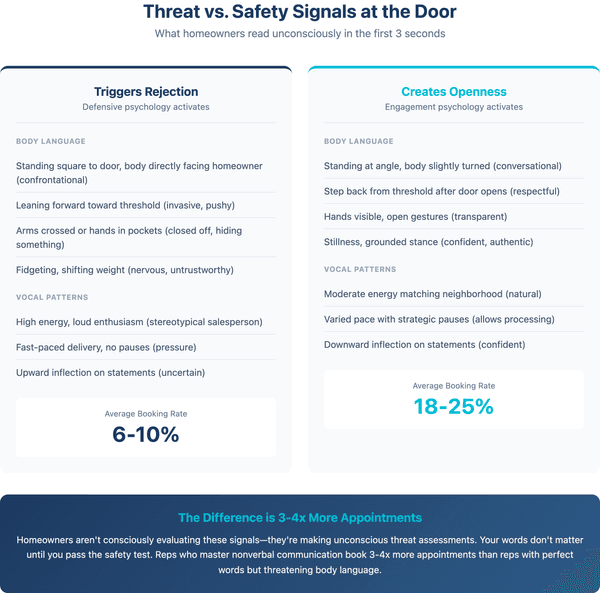
Standing square to the door, body directly facing the homeowner, creates confrontational energy. Homeowners' brains interpret this as aggressive positioning. Leaning forward or stepping toward the threshold conveys pushiness, even if you're just enthusiastic. Arms crossed or hands in pockets signals closed-off energy that homeowners mirror unconsciously.
The alternative: Stand at an angle to the door, body slightly turned away. This creates non-confrontational energy—you're positioned like a neighbor having a casual conversation, not a salesperson making a pitch. Take a step back from the threshold after they open the door. This single movement dramatically reduces psychological defensiveness. Keep hands visible and open with natural gesturing. Homeowners' brains unconsciously read this as "nothing to hide."
Your vocal patterns matter just as much. High energy and loud enthusiasm sound like stereotypical salesperson energy, triggering immediate categorization. Fast-paced delivery with no pauses conveys pressure. Research from the University of Southern California on vocal perception demonstrates that listeners form trust assessments based on vocal patterns within three seconds, predicting engagement likelihood with 73% accuracy.
Match the neighborhood's atmosphere. Vary your pace with strategic pauses that allow homeowners' brains to process information. Use downward inflection at statement endings to convey confidence. Mirror the homeowner's vocal energy—if they speak softly, you soften.
Threat vs Safety Signals
What homeowners read unconsciously: Square stance, forward lean, crossed arms, and high-energy vocal patterns trigger defensive psychology within milliseconds. Angled stance, stepped-back positioning, open hands, and matched vocal energy create psychological safety that allows genuine conversation. The difference in appointment booking rates between these approaches is 3-4x.
The Moment You Destroy Everything You Built
There's a specific moment where most reps accidentally trigger the defensive responses they've carefully avoided: the transition from conversation to ask.
The rep built rapport. The homeowner is engaged. Then: "So when can I come by and take a look? How's Thursday at 2pm work?"
The sudden shift in energy destroys everything. The rep went from consultative to transactional too abruptly. The homeowner's brain recognizes "here comes the sales pitch" and barriers activate immediately. The problem: You revealed the friendly conversation was just setup for the ask. The homeowner feels manipulated.
Instead of pivoting to the ask, position it as a natural next step in a process the homeowner is already bought into. "Given what you're describing about that water stain, it'd make sense to have someone get up there and see what's going on. I can document everything properly so you have evidence if you need to file a claim. Would next week work, or is this weekend better?"
The difference: You're not asking for an appointment out of nowhere. You're suggesting a logical next step based on a problem the homeowner acknowledged. The appointment serves their needs, not yours. According to research from the Journal of Consumer Psychology on autonomy, giving consumers explicit choice increases purchase likelihood by 40-60% compared to persuasion-based approaches.
The Territory Psychology That Compounds Over Time
Individual appointment psychology matters, but there's a bigger game happening at the neighborhood level that most reps completely miss. Every door interaction affects how neighbors perceive your company weeks or months later.
Homeowner A has a terrible experience with your rep—pushy energy, manipulative tactics, bad vibes. They don't book, and they're left feeling annoyed. Homeowner A tells Homeowners B, C, and D about "that aggressive roofing guy." Two weeks later, when a different rep from your company knocks Homeowner C's door, their brain has pre-loaded psychological defenses based on Homeowner A's story.
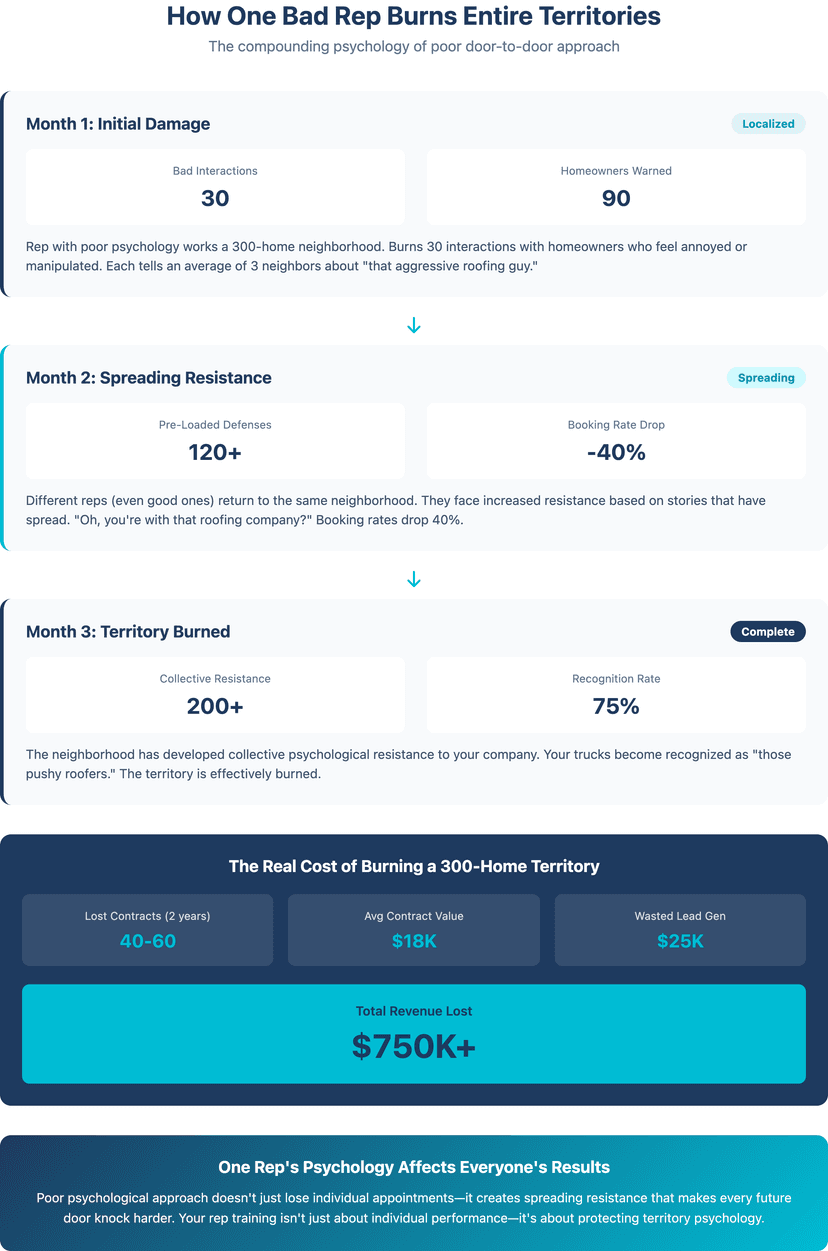
This compounds devastatingly. Month one: Rep with poor psychology burns 30 interactions. Those 30 homeowners tell 90 others. Month two: Different reps return to the same neighborhood facing increased resistance. Their booking rates drop 40% compared to neighborhoods without prior negative interactions. Month three: The neighborhood has developed collective resistance to your company. Your trucks become recognized as "those pushy roofers."
Research on social transmission of threat perception shows people adopt defensive behaviors toward threats others have warned them about, even without direct negative experience. Your rep's bad psychology becomes everyone's problem.
Territory Psychology Compounding
How one bad rep burns entire neighborhoods: A single rep with poor psychology doesn't just lose individual appointments. They create spreading psychological resistance that makes every future door knock harder. One rep burning 30 interactions leads to 90 homeowners warned, then 40% lower booking rates for all future reps, then entire territories that develop collective resistance to your company.
What Actually Books Appointments
After analyzing thousands of door interactions, appointments get booked when homeowners feel three psychological states simultaneously: psychological safety (the interaction doesn't feel threatening or manipulative), competent trust (the rep knows what they're talking about), and autonomy preservation (they're choosing to book based on their own assessment, not being convinced).
When all three exist, booking feels natural. When any one is missing, resistance emerges.
The reps booking 18-25% understand homeowner psychology. They know first impressions happen in milliseconds based on nonverbal cues. They leverage reciprocity without obligation, social proof that's specific and verifiable, and curiosity gaps that engage instead of information dumps that overwhelm. They position appointments as the homeowner's choice, not the rep's goal.
Companies training reps on psychology are booking 18-25% while script-focused competitors struggle at 6-10%. Companies ignoring psychology burn territories through approaches that trigger defensive responses, then wonder why door knocking "doesn't work anymore."
Your competitors are learning this right now. The ones who understand psychology are dominating while script-followers wonder why their "perfect pitch" keeps failing.
Homeowners don't reject your words. They reject the psychological patterns you trigger before words even matter. Master the first three seconds, and everything else gets easier.
If you want to operationalize this for roofing teams, pair Echo with the canvassing script generator and the role play scenario generator so reps can rehearse the body language, tone, and opener before they burn a neighborhood.
Want to see how this works for your team? Book a 15-minute demo and we'll walk through your specific use case.
Frequently Asked Questions
How quickly do homeowners form first impressions at the door?
Homeowners form initial impressions within 100 milliseconds based on nonverbal cues like stance, facial expression, and positioning. These snap judgments predict final engagement decisions with 90% accuracy, meaning the first three seconds determine whether homeowners will listen to your pitch or execute polite rejection scripts.
What body language makes door knockers seem threatening?
Standing square to the door with body directly facing the homeowner, leaning forward toward the threshold, keeping arms crossed or hands in pockets, and fidgeting or shifting weight constantly all trigger unconscious threat assessment in homeowners' brains. These signals activate defensive psychology before words begin.
Why do homeowners reject reps who say the right words?
Homeowners make unconscious psychological assessments about threat, trust, and autonomy before consciously evaluating words. If your nonverbal communication (body language, vocal tone, physical positioning) triggers defensive patterns in the first three seconds, perfect scripts work uphill against resistance that formed before you spoke.
How does one bad rep affect future appointments in a neighborhood?
One rep with poor psychology doesn't just lose individual appointments—they create spreading resistance. Homeowners who have negative experiences tell 3-5 neighbors on average. When your company returns to that neighborhood weeks later, homeowners have pre-loaded psychological defenses based on stories they've heard, reducing booking rates by 40%+ compared to neighborhoods without prior negative interactions.
What's the difference between high-performing and average door-to-door reps?
Top performers (18-25% booking rates) focus on managing the psychological patterns they trigger in the first three seconds through deliberate body language, vocal tone, and positioning. Average performers (6-10% rates) focus on perfecting scripts while ignoring the nonverbal communication that determines whether homeowners engage or dismiss before words matter.
How can reps improve their nonverbal communication at doors?
Practice standing at an angle to the door rather than square, take a step back from the threshold after homeowners open the door, keep hands visible with open gestures, match the neighborhood's vocal energy rather than bringing high-energy enthusiasm, and use strategic pauses in speech to reduce cognitive load. Record yourself at practice doors to identify unconscious threatening patterns.
📚 Related Articles
Free tools for door-to-door reps
Give canvassers something they can use today
Pair the strategy in this article with free tools for scripts, door hangers, homeowner texts, and field follow-up.
Field sales tools
Generate homeowner texts, canvassing assets, inspection summaries, and follow-up language.
Browse field sales tools →Training tools
Build knock tracks, objection handlers, and practice scenarios before reps burn live doors.
Browse training tools →Echo
Support reps live in the field with in-ear coaching during real conversations.
See Echo →About the Author
Tim Nussbeck
Founder & CEO of GhostRep
Two decades in roofing—knocking doors, running teams, training 1,000+ reps. Built GhostRep to give every rep access to the coaching top teams get.
Field next step
Give your reps something they can use before the next knock
Start with field and training tools if you need talk tracks, follow-up language, or canvassing assets now. Book a walkthrough if you want GhostRep mapped to live field coaching.
- ✓Best fit if reps need sharper first knocks and second visits.
- ✓Useful for follow-up language, inspection texts, and canvassing flow.
- ✓Demo shows how Echo and Role Play support real field conversations.
Start Here
Browse field sales tools
Create homeowner texts, canvassing assets, inspection summaries, and follow-up copy.
Browse field sales toolsNeed it mapped to your team?
Talk through your current workflow, traffic mix, and where GhostRep fits before you change anything.
Book a 15-minute walkthroughYou Might Also Like
Map My Customers routes your rep back to every warm lead. It can't prepare them for a homeowner who already heard the pitch and said not yet.
Read article →D2D CRM shows you exactly which rep is failing. GhostRep gives you the tools to fix it. Measuring the gap and closing it require two different platforms.
Read article →RepCard and GhostRep both use AI to fix roofing close rates. They disagree on where the problem lives. That distinction matters more than you'd think.
Read article →