Your new hire quit Thursday morning. Week four.
He was perfect on paper. Former restaurant manager who handled difficult customers for six years, solid work ethic, genuinely hungry for commission income. You invested two hours walking him through contracts, had him shadow your top closer for three days, handed him door hangers and sent him out.
He knocked 200 doors over two weeks. Got rejected 197 times. Closed zero deals. Decided "sales isn't for me" and went back to restaurant management at $18/hour.
You just burned $150,000. That's the inflation-adjusted cost of a failed sales hire according to DePaul University's Center for Sales Leadership research—originally $114,957 in 2012, now exceeding $150k when you factor recruitment, your training time, lost deals, and reputation damage when untrained reps burn your market.
The rep wasn't the problem.
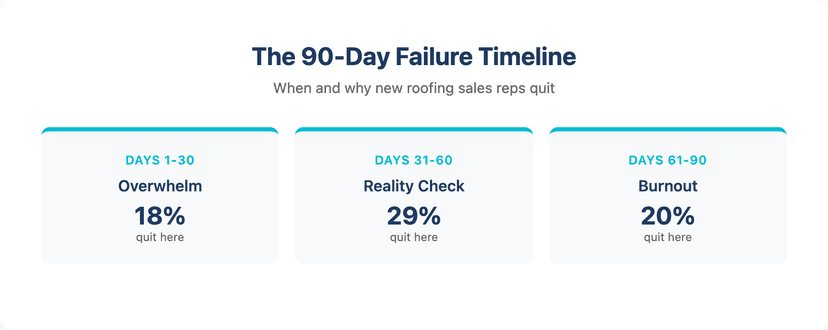
Becca Switzer from Roof Sales Mastery reports that over 90% of brand new roofing salesmen quit within the first few weeks simply because they had insufficient training. Not because they couldn't handle rejection. Because companies teach them wrong.
After training 1,000+ roofing sales reps across 12 states, I can tell you exactly what kills new hires: you're teaching the right skills in the completely wrong order.
📊 What Traditional Training Looks Like
This happens because you're dumping product knowledge, pricing structures, objection frameworks, and closing techniques on someone who can't confidently have a 30-second conversation with a skeptical homeowner.
That's not training. That's cognitive overload.
🚫 The Fatal Flaw: Teaching Product Knowledge First
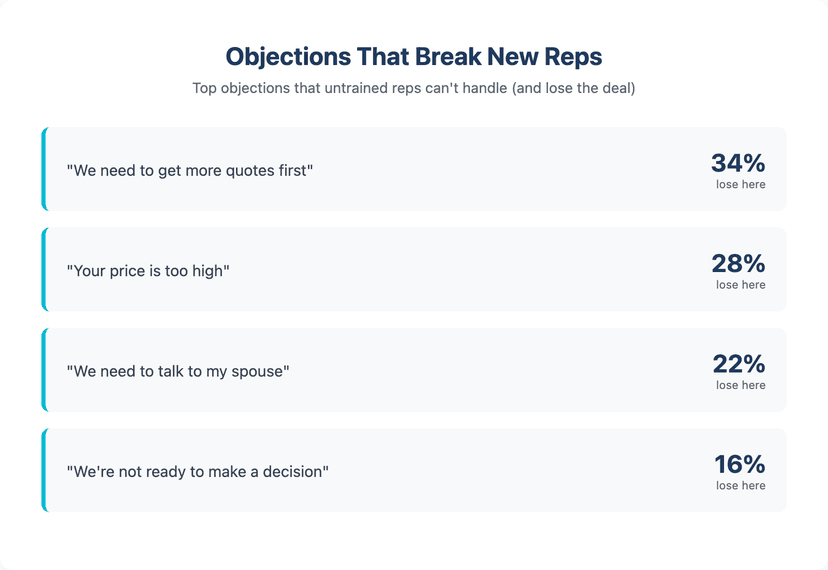
Walk into any roofing orientation and you'll hear the same shit. Shingle specifications. Underlayment options. Flashing types. Ventilation systems. Manufacturer warranties. The rep's notebook fills with technical details they'll never remember when it matters.
But when a skeptical homeowner opens the door and says "I'm not interested in salespeople," your rep freezes.
All that product knowledge is useless if they can't navigate the first 30 seconds. They default to an information dump, hoping technical knowledge creates credibility.
Homeowners don't care about shingle specs in the first 30 seconds. They care whether this person is trustworthy. Your rep sounds like every other salesperson. Homeowner shuts down. Rep gets rejected repeatedly. Rep quits.
🎯 The Skills That Actually Matter (In The Right Order)
Elite companies don't teach more skills. They teach the same skills in the order humans actually learn them.
Each skill unlocks the next one. Conversation confidence lets you have damage identification discussions. Spotting damage creates the reason for inspections. Inspections provide data for proposals. Proposals give context for objections. Handling objections leads to closes.
Taught in this order, skills stack naturally. Taught out of order, they remain disconnected.
📊 Traditional vs Sequential Training: The Real Cost
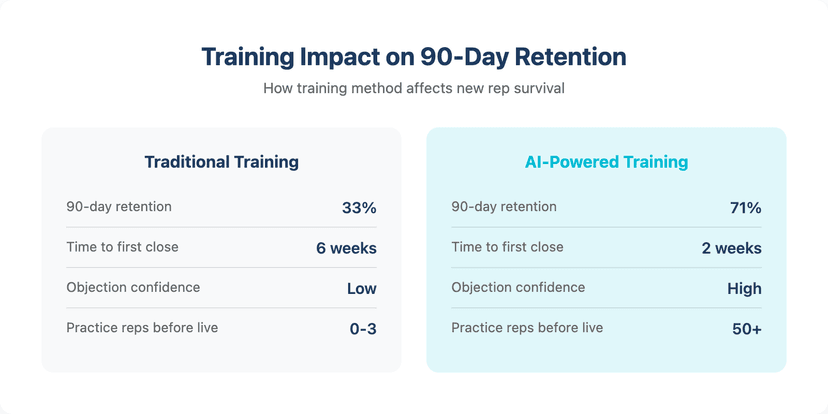
Same hiring budget. Triple the output. One-fifth the cost.
⚙️ Why Sequencing Matters
You're not teaching different information. You're teaching the same information in an order that matches how humans actually learn.
Confidence compounds or collapses. A rep who can confidently start conversations gets positive responses early. That feedback builds confidence. They show up at more doors. More doors means more practice. More practice accelerates development.
A rep who gets rejected repeatedly because they lead with product information starts dreading doors. Anxiety increases. They avoid doors. Less practice means slower development. The failure spiral accelerates until they quit.
Research from Allego shows that 50% of sales leaders report onboarding has been so stressful on some new hires that they quit. That stress comes from repeated early failure that better sequencing prevents.
Pattern recognition requires context. You can't effectively teach objection handling to someone who hasn't encountered objections in real situations. The patterns are abstract until the rep has personally experienced the frustration of not knowing how to respond.
Studies show B2B sales reps forget 70% of information within one week of training. Information taught without context gets forgotten because the brain hasn't identified it as important yet.
❌ Why Companies Keep Using Broken Training
The "Throw Them in the Deep End" Philosophy: Many companies believe sales is inherently sink-or-swim. "Either they have it or they don't." This justifies minimal training investment.
The successful reps become managers who perpetuate the same approach. This occasionally works—for natural salespeople. But those represent maybe 10% of candidates. Research shows 62% of organizations report their sales onboarding programs are ineffective.
Companies using proper sequencing aren't just capturing natural salespeople—they're developing competent reps from people who would have failed under sink-or-swim.
Imitating B2B Training: Some companies adapt B2B sales training for roofing. These programs emphasize product knowledge and consultative questioning—sequenced for industries where the salesperson already has a relationship with the buyer.
Roofing is door-to-door prospecting where the homeowner didn't request the interaction. The skills required to get from "unwanted stranger" to "person I'm willing to talk with" are fundamentally different.
🛠️ How to Actually Implement This
Create Stage-Specific Materials: You need training content designed for each stage. Not generic sales training—materials for teaching conversation confidence separately from damage identification separately from pricing. Start with a structured onboarding plan so new reps know exactly what to do in their first 30 days.
A rep in the conversation stage should practice door approaches dozens of times before knocking actual doors.
GhostRep Solution: We built stage-specific training modules. Early reps work exclusively on conversation confidence using AI Role Play. Later reps access 1,000+ objection scenarios in Objection Mastery and our free objection handler tool. The platform gates progression—reps can't advance until they've demonstrated competence.
Implement Stage Gates: Reps shouldn't advance until they've demonstrated competence in the current stage. After conversation training, the rep should demonstrate confidence through assessed roleplay. If they can't comfortably initiate conversations in a simulated environment, they're not ready for damage identification.
GhostRep Solution: Our platform has built-in stage gates using AI assessment. The AI evaluates roleplay performance across specific competencies. Reps must achieve minimum scores before unlocking next content.
Track Leading Indicators: Traditional metrics track results: deals closed, revenue generated. These are lagging indicators that tell you whether the rep is succeeding but not why they're failing.
Sequential training requires tracking leading indicators at each stage: conversation initiation success, damage ID accuracy, safety protocol compliance, proposal accuracy, objection handling competency.
These identify exactly where a struggling rep is breaking down.
🚀 The Competitive Advantage
While your competitors continue losing 90% of new hires, implementing proper sequencing creates a competitive advantage that compounds.
Expanding Your Talent Pool: When you're not dependent on finding natural salespeople, you can hire based on work ethic, coachability, and cultural fit. Former teachers, military veterans, restaurant managers—people who can learn systematic processes. These candidates are often more reliable and loyal than career salespeople.
Reducing Replacement Costs: Every failed hire costs $150k+. Reducing early-stage failures from 90% to 30-40% dramatically improves unit economics. The same budget produces three times as many productive reps.
Those savings compound. Money not spent replacing failed hires can be invested in better compensation for productive reps, which improves retention, which reduces recruiting pressure.
Building Organizational Knowledge: When reps succeed through systematic skill development, your company accumulates structured knowledge about what works. Each cohort provides data about which stages need refinement. Your training gets better while competitors' training remains unchanged.
⚠️ The Implementation Reality
Most roofing companies won't implement this correctly even after agreeing it makes sense. The sink-or-swim approach feels faster. Sales managers don't want to create stage-specific materials. Owners don't want to wait to see results.
This creates opportunity for companies willing to do the harder work upfront. While competitors continue burning $150k per failed hire and losing 90% of new reps, you're systematically developing productive reps from ordinary candidates.
The question isn't whether skill sequencing works better—the data clearly shows it does. The question is whether your organization will do the unglamorous work of building systematic training when defaulting to "throw them in the deep end" feels faster.
Your answer determines whether you're still losing 90% of new hires next year or whether you've become the company known for developing top producers while competitors can't figure out why nobody will work for them.
Want to see how this works for your team? Book a 15-minute demo and we'll walk through your specific use case.
About the Author
Tim Nussbeck
Founder & CEO of GhostRep
Two decades in roofing—knocking doors, running teams, training 1,000+ reps. Built GhostRep to give every rep access to the coaching top teams get.
The GhostRep Advantage
One Platform. Closed Loop System.
Every interaction makes your team better. AI that learns, adapts, and improves with every rep.
Hire
AI screens candidates
Train
1,000+ scenarios
Coach
Real-time guidance
Analyze
AI learns & improves
You Might Also Like
Your new rep starts Monday. You've got him scheduled for 10 weeks of ride-alongs, product training videos, and shadowing. By Week 12, he'll be ready to knock his first door solo. Except he won't make it to Week 12. According to industry research, 43% of new sales reps leave within the first 90 days. Your 12-week onboarding plan puts his first real appointment around Day 84—right when most quit. Here's the disconnect: traditional onboarding treats roofing sales like enterprise software sales. I
Your rep closes 18% of qualified appointments. Team average is 32%. He's been with you four months. You hired him because he had door-to-door experience and crushed his interview. Now he's burning through your best storm-damaged territories and converting nothing. You're thinking about firing him. Before you do, read this. Before You Fire: Most Underperformers Are Fixable Here's what most managers don't know: Only 46.7% of sales reps globally meet quota according to Sales Hacker's industry a
Remote training delivers 10x more practice scenarios than traditional methods. Get roofing reps closing in 3-4 weeks instead of 8-12 weeks.