
Your rep was closing 35% of appointments last month. This month they're at 19% and falling.
You ask them what's wrong. They tell you "the leads are bad" or "it's just a slow month" or "people aren't buying right now."
They're lying. Not maliciously—they probably don't even know they're lying. But they are.
Here's what's actually happening: Something changed. Maybe it's burnout. Maybe they stopped following your process. Maybe they're dealing with personal shit they won't tell you about. Maybe they got comfortable and lazy. Maybe another company offered them more money and they're already mentally checked out.
Your job isn't to accept their bullshit excuse. Your job is to diagnose the real problem fast, fix it if you can, or cut them loose if you can't.
Because every week you let a rep run at 19% instead of 35%, you're burning $8,000-12,000 in lost revenue. Do that for a month and you just flushed $35,000-50,000 because you were too nice to have a hard conversation.
Here's how to actually diagnose and fix close rate drops before they destroy your numbers.
The Five Real Reasons Close Rates Drop (And What They'll Tell You Instead)
Reps always blame external factors they can't control. Your job is to find the internal factor you can fix.
"Leads are bad this month" → They're getting the same leads as everyone else but can't close them anymore. When your other reps are closing 32% on the same lead source and this rep is at 19%, the leads aren't the problem.
"People aren't ready to buy" → They stopped asking for the sale or lost confidence in closing. Storm-damaged roofs don't get better with time. If homeowners aren't "ready to buy," your rep lost control of the conversation.
"I'm working harder than ever" → They're burned out and going through the motions without actual effort. Nearly 90% of sellers report burnout, and burned-out reps work more hours while producing less. It's biology, not laziness.
"The market changed" → They stopped adapting their pitch or handling new objections. The roofing market didn't suddenly shift in three weeks. Their objection handling got sloppy.
"I just need a few more leads" → They're wasting leads with poor execution and want more to burn through. More leads won't fix broken skills—they'll just waste more money.
Step 1: Run the Numbers (Don't Trust Your Gut)
Before you have any conversation, pull the actual data. Here's what you need to know:
Activity Metrics: Doors knocked per day (should be consistent at 50-80), appointments booked per 100 doors (should be stable at 8-15%), appointments actually showed up to (are they flaking?), average appointment length (getting shorter = giving up faster).
Conversion Metrics: Close rate by lead source (is it all leads or specific ones?), close rate by appointment type (door knock vs storm chasing vs insurance referral), average contract value (are they discounting GAF systems to try to close?), time from appointment to close (taking longer = losing confidence).
Comparison Metrics: Their current numbers vs their historical average, their numbers vs team average on same lead sources, their numbers vs your best rep on same lead sources.
If their close rate dropped but their activity stayed the same, it's a skill or mindset problem. If both dropped, it's burnout or they're checked out.
Watch for roofing-specific red flags: Storm season fatigue (hitting doors 60+ hours a week for 8 weeks straight), insurance objection avoidance (suddenly getting "my insurance won't cover it" on every appointment), material discounting (offering Owens Corning Duration at Timberline HDZ prices just to get signatures).
Step 2: Identify the Pattern (Symptoms Tell You Everything)
Close rate drops don't happen randomly. There's always a pattern. Here's how to spot it:
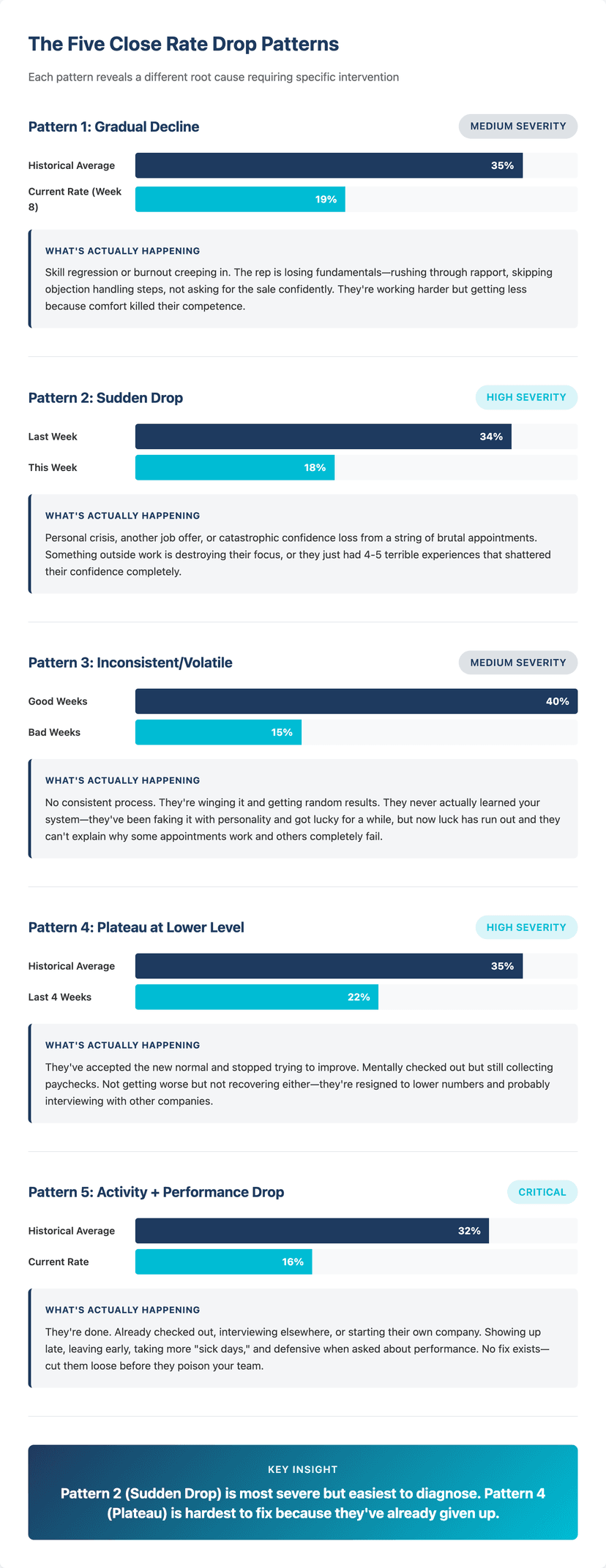
Pattern 1: Gradual Decline Over Weeks/Months
Close rate drops 2-3% per week consistently. Activity stays same or increases (working harder, getting less). Rep seems frustrated but still showing up. Starting to complain about leads, market, pricing.
What's happening: Skill regression or burnout creeping in. They're losing fundamentals—rushing through rapport, skipping objection handling, not asking for the sale confidently. Comfort kills competence. They got good, then stopped practicing the basics. Common mid-storm season when reps have been knocking 60+ hours a week for six weeks straight.
Pattern 2: Sudden Drop (Week-to-Week)
Close rate drops 10-15%+ in one week. Activity might drop too. Rep seems distracted or less engaged. Showing up late, leaving early, taking more "sick days."
What's happening: Personal crisis, another offer, or catastrophic confidence loss from a string of bad appointments. Something outside work is destroying their focus, or they just had 4-5 brutal appointments in a row that shattered their confidence. In roofing, this often follows a homeowner filing a complaint with the state licensing board or threatening legal action.
Pattern 3: Inconsistent/Volatile (Up and Down)
Close rate swings wildly week to week (40% one week, 15% the next). Some appointments go great, others are disasters. Rep can't explain why some work and others don't. Blames "luck" or "tough crowds."
What's happening: No consistent process. They're winging it and getting random results. They never actually learned your system—they've been faking it with personality and got lucky. This rep kills it with storm-damaged roofs (easy sell, insurance pays) but completely bombs on aged roof replacements that require selling value.
Pattern 4: Plateau (Stuck at Lower Number)
Close rate dropped and stayed at new lower level. Not getting worse but not recovering either. Rep seems resigned to new numbers. Stopped trying to improve.
What's happening: They accepted the new normal. Gave up trying to get back to their old numbers. Mentally checked out but still collecting paychecks. Probably interviewing elsewhere. Often happens when a rep gets passed over for a crew lead position or loses a big storm territory to another rep.
Pattern 5: Activity Drop + Performance Drop
Both close rate AND activity declining simultaneously. Showing up late regularly. Taking more "sick days." Defensive when asked about numbers.
What's happening: They're done. Checked out completely. Already interviewing with competitors, starting their own company, or just don't give a shit anymore. Watch for reps who suddenly start asking detailed questions about your Owens Corning manufacturer rebates or insurance supplement process—they're gathering intel to launch their own operation.
Step 3: The Diagnostic Conversation (Spot the Lies)
Now you talk to them. But you're not asking "what's wrong?" because they'll give you bullshit. You're asking specific questions designed to reveal the truth.
"Walk me through your last 5 appointments. What happened at each one?"
Listen for: Do they remember details or are they all blurry? Are they following your process or improvising? Do they sound engaged or defeated? Can they identify what went wrong or do they blame homeowners? Red flags: "The homeowner just wasn't interested" (too vague), "They were shopping price" (didn't establish value first), "Insurance wouldn't cover it" (didn't pre-qualify or handle objection).
"What objection are you hearing most right now?"
Listen for: Is it actually a new objection or one they should know how to handle? Are they handling it well or freezing up? Do they blame the objection or take ownership? Red flags: "I need three quotes" is Level 1 objection handling. If a veteran rep suddenly can't handle this, something's broken. "My insurance adjuster says I don't need a full replacement" appears in every storm territory—if they're struggling with it now, they've regressed.
"What's different about this month compared to when you were closing 35%?"
Listen for: Do they take any responsibility or blame everything external? Can they identify what they changed or do they insist nothing changed? Are they defending themselves or genuinely trying to figure it out?
"If you could only work 20 hours this week, what would you do differently?"
This reveals priorities. Burned out reps will say "I'd sleep more" or make jokes. Engaged reps will say "I'd focus only on my hottest insurance leads and nail every appointment."
The tell: If they can't give you specific examples and keep speaking in generalities, they're bullshitting you. Either they don't know what's wrong or they know but won't tell you.
Step 4: The Fix (Specific Solutions for Each Problem)
Now you know what's wrong. Here's how to fix it.
If It's Skill Regression
The Problem: They stopped doing the fundamentals. Skipping rapport building, rushing to price, not handling objections, failing to ask for the sale.
The Fix: Record their next 3 appointments (audio or shadow them). Identify exactly where they're failing—are they rushing the roof inspection and missing damage? Presenting CertainTeed Landmark without explaining why it's better than the neighbor's Timberline HDZ? Folding on the first "I need three quotes" objection?
Practice that specific skill 20-30 times until it's smooth again. GhostRep's Objection Mastery gives them unlimited practice reps on whatever objection is killing them—"insurance won't cover it," "my neighbor paid $8,000 less," "I need to wait until after storm season." Our free objection handler tool is a quick way to prep responses before their next appointment.
Timeline: Should see improvement within 1-2 weeks if they're coachable. If not, they're not skill-regressed—they're checked out.
If It's Burnout
The Problem: They're exhausted. Working too many hours, neglecting health, relationships suffering. The dopamine hit from closing deals stopped covering the stress. Research shows 77% of workers experience work-related stress, with burnout symptoms in 57%.
The symptoms you missed: Working later hours but producing less, skipping lunch breaks, not taking days off during 8-week storm season pushes, health declining (gaining/losing weight, looking tired), personal relationships deteriorating.
The Fix: Mandatory time off (3-5 days minimum, actually unplugged). Storm season FOMO is real, but a burned-out rep closing 19% is worse than being down one rep for a week. Reduce daily door-knocking hours temporarily (6 hours instead of 8). Focus on high-probability leads only—insurance supplement follow-ups, aged storm damage, referrals. Skip the cold door-knocking grind temporarily.
Timeline: 2-3 weeks to see if reset works. If numbers don't recover, move to cutting them loose.
If It's Process Breakdown
The Problem: They never actually learned your system. They've been improvising and it stopped working.
The Fix: Back to basics training (treat them like a rookie). They need to relearn how to properly inspect a roof and document damage for insurance, present material options without overwhelming the homeowner, handle the "I need three quotes" objection in the first 10 minutes, close on-site instead of "I'll send you a proposal."
Shadow your best rep for 10 appointments. Not just riding along—actively taking notes. Mandatory role-play practice before every field day using GhostRep's progressive training or our role play scenario generator—start at Level 1 until they master fundamentals again.
Timeline: 3-4 weeks if they're trainable. If they resist going back to basics ("I already know this stuff"), cut them loose.
If It's Personal Crisis
The Problem: Divorce, sick family member, financial stress, substance abuse—something outside work is destroying their ability to focus.
The Fix: You can't fix their personal life. You can offer temporary reduced schedule (with understanding it means lower pay), resources if it's substance abuse (EAP, rehab support if available), clear timeline for when they need to be back to full performance.
Roofing reality: Storm season doesn't pause for personal crises. If they can't perform during the 12-16 weeks when you make 70% of annual revenue, you can't carry them.
Timeline: 30-60 days max. If they can't get back to performing after 60 days, you can't carry them anymore.
If They're Checked Out
The Problem: They're interviewing elsewhere, starting their own company, or just don't give a shit anymore.
The symptoms: Defensive when you ask about performance, making excuses instead of taking responsibility, suddenly "too busy" for coaching or practice, activity numbers dropping along with close rate, asking detailed questions about your supplier relationships or manufacturer programs.
The Fix: There is no fix. They're done. Cut them loose before they infect your team with their bullshit attitude or steal your customer list to start competing.
Timeline: Immediate. Have the conversation this week.
The 30-Day Test (Prove It or Lose It)
Whatever the diagnosis, here's the framework:
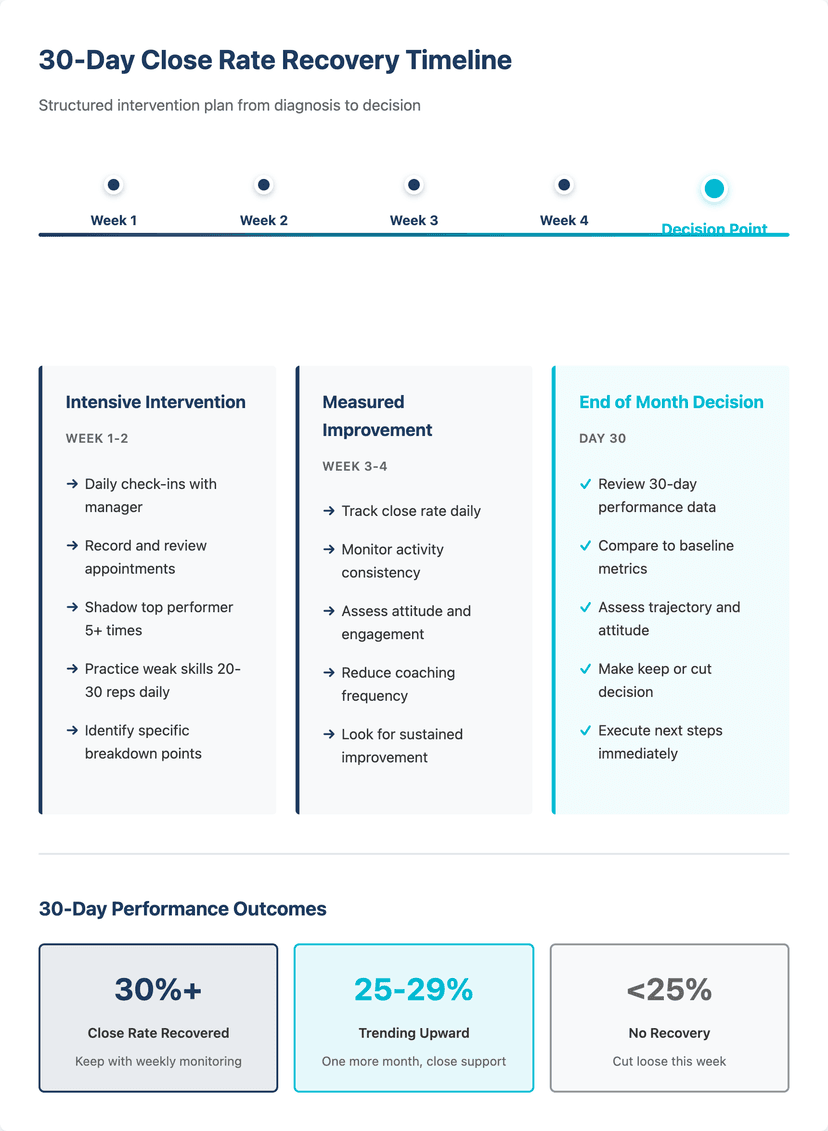
Week 1-2: Intensive Intervention. Daily check-ins, practice sessions, shadow best rep, specific skill work on their weakness.
Week 3-4: Measured Improvement. Close rate should be trending back up, activity should be consistent, attitude should be improving. If none of these are happening, intervention failed.
End of Month 1 Decision. Close rate back to 30%+ = fixed, keep monitoring. Close rate 25-29% = trending right direction, one more month with close support. Close rate under 25% = not fixable or not motivated, cut them loose this week.
The hard truth: If they're not back to at least 80% of their peak performance within 30 days of intensive intervention, they're not coming back. Stop wasting time and money. Rep performance typically declines after 2-3 years, and burned-out employees cost about 34% of their salary in lost productivity.
How GhostRep Prevents This Problem Before It Starts
Here's what most managers miss: By the time you notice the close rate drop, the problem has been growing for weeks.
Your rep started struggling with "I need three quotes" in week one. Instead of practicing it, they avoided homes where they'd hear it. Then it spread to "my insurance won't cover it." Then confidence dropped. Then effort dropped. Then numbers tanked.
By the time you see the 19% close rate, they've already lost 4-6 weeks of performance you can't recover.
GhostRep catches this in real-time. The AI tracks every practice session. When a rep suddenly stops practicing or starts failing scenarios they used to pass, you get flagged immediately. Not after their close rate tanks—while they're still performing but showing early warning signs.
Your rep gets: "You failed the 'I need three quotes' objection 4 times this week. That's unusual for you. Let's practice it 10 more times."
Your manager gets: "Rep performance declining in objection handling. Recommend intervention before field performance drops."
You fix the problem while they're still closing 35%, not after they drop to 19% and cost you $50,000 in lost revenue.
Ghost Rep catches it at the appointment. Your rep is fumbling the "my insurance adjuster said I only need repairs" objection. Ghost Rep (real-time AI coaching through Bluetooth earpiece) feeds them the exact rebuttal: "Your adjuster wrote for repairs because that's their first assessment. Once we document the full extent of wind damage—broken seals, granule loss, compromised underlayment—they'll revise to a full replacement. I've done this 200 times."
The rep recovers, closes the deal. Later, the system logs: "Rep needed help with insurance objection 3 times this week. Recommend focused practice."
When to Coach vs When to Cut
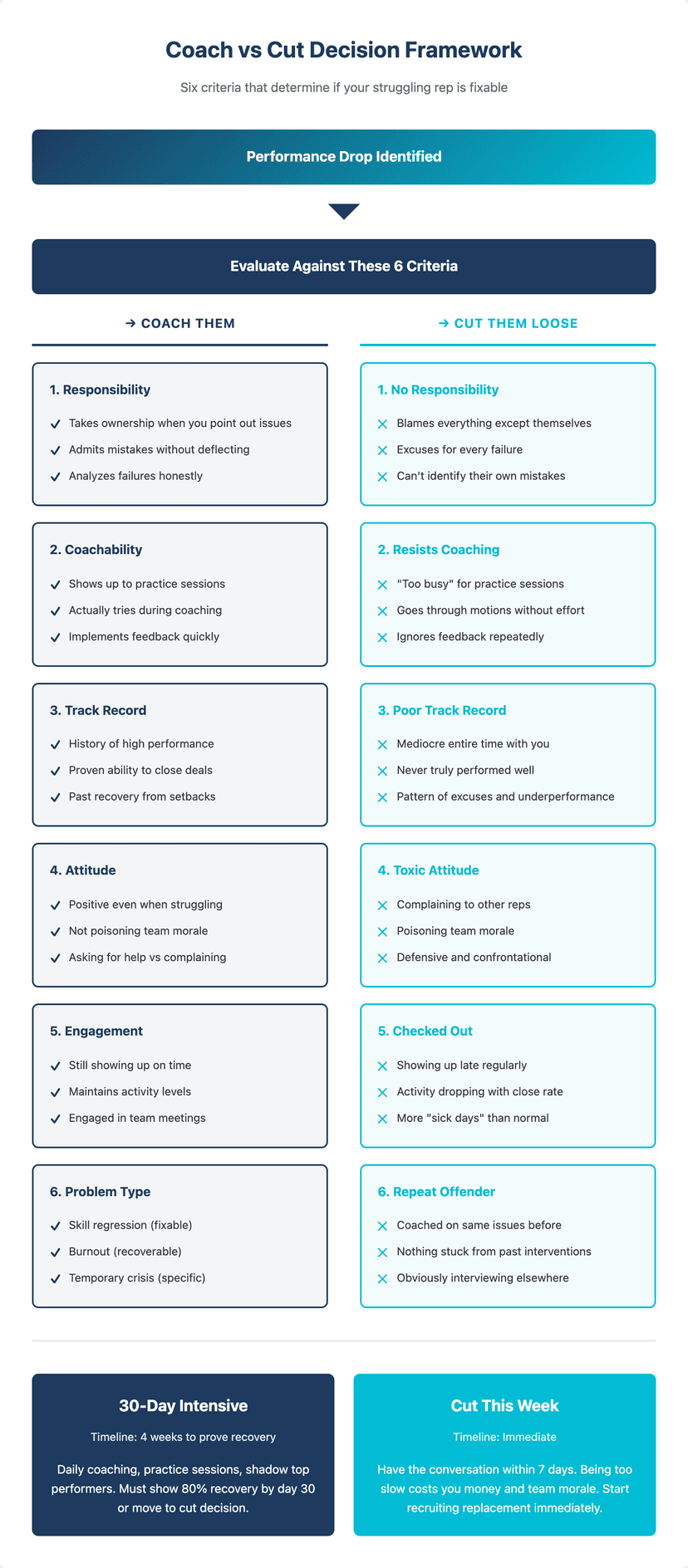
Coach them if: They take responsibility when you point out the problem, they show up to practice sessions and actually try, they have a history of high performance with you, their attitude is good even if their numbers aren't, they're asking for help instead of making excuses.
Cut them loose if: They blame everything except themselves, they resist coaching or "don't have time" to practice, they've been mediocre their entire time with you, their attitude is poisoning other reps, they're obviously interviewing elsewhere, you've coached them before on similar issues and nothing stuck.
The math: A rep closing 19% instead of 35% on 100 monthly appointments at $12K average job = $19,200 monthly revenue loss. If you spend 2 months trying to fix them and fail, you just lost $38,400 plus the opportunity cost of not having someone better in that seat.
Being too nice costs you money. Being too harsh costs you talent. Being too slow costs you both.
What Changes This Week
Pick your struggling rep. You know who it is.
Monday: Pull their numbers. Compare to team average and their historical performance. Identify the pattern.
Tuesday: Have the diagnostic conversation. Ask the four questions. Listen for bullshit.
Wednesday: Decide on the fix based on actual diagnosis, not what they told you.
Thursday-Friday: Implement intensive intervention. Daily practice if it's skills. Mandatory time off if it's burnout. Performance plan if it's process.
Week 2-4: Monitor daily. If no improvement by week 3, start recruiting their replacement.
End of Month: Close rate is back above 30% or they're gone.
Your team is watching how you handle this. If you let one rep run at 19% for months while making excuses, every other rep will think mediocre performance is acceptable.
If you diagnose fast, intervene hard, and cut loose when it's not working, your team knows you hold a standard.
The reps who can perform will respect you for it. The reps who can't will quit before you have to fire them.
Word Count: 2,487 words
About the Author
Tim Nussbeck
Founder & CEO of GhostRep
Two decades in roofing—knocking doors, running teams, training 1,000+ reps. Built GhostRep to give every rep access to the coaching top teams get.
The GhostRep Advantage
One Platform. Closed Loop System.
Every interaction makes your team better. AI that learns, adapts, and improves with every rep.
Hire
AI screens candidates
Train
1,000+ scenarios
Coach
Real-time guidance
Analyze
AI learns & improves
You Might Also Like
Your new rep starts Monday. You've got him scheduled for 10 weeks of ride-alongs, product training videos, and shadowing. By Week 12, he'll be ready to knock his first door solo. Except he won't make it to Week 12. According to industry research, 43% of new sales reps leave within the first 90 days. Your 12-week onboarding plan puts his first real appointment around Day 84—right when most quit. Here's the disconnect: traditional onboarding treats roofing sales like enterprise software sales. I
Your rep closes 18% of qualified appointments. Team average is 32%. He's been with you four months. You hired him because he had door-to-door experience and crushed his interview. Now he's burning through your best storm-damaged territories and converting nothing. You're thinking about firing him. Before you do, read this. Before You Fire: Most Underperformers Are Fixable Here's what most managers don't know: Only 46.7% of sales reps globally meet quota according to Sales Hacker's industry a
Remote training delivers 10x more practice scenarios than traditional methods. Get roofing reps closing in 3-4 weeks instead of 8-12 weeks.