You have 47 training videos sitting in a Google Drive folder.
Your newest rep has watched exactly 2 of them. Your top performer hasn't opened the folder in six months. And yesterday, a homeowner asked about GAF's Lifetime Protection Plus warranty, and your $80K closer had no idea what to say.
Here's the problem: You don't have a training library. You have a video graveyard.
Most roofing companies confuse accumulating content with building capability. They record ride-alongs, save presentation decks, bookmark YouTube videos from industry trainers, and call it a "training library." Then they wonder why reps still fumble objections, misquote warranties, and forget to ask for referrals.
The gap isn't information. It's execution.
Your reps don't need 47 videos explaining how to handle price objections. They need 47 practice conversations where they actually handle price objections and get instant feedback on what worked and what tanked.
🎯 What Makes a Training Library Effective
Let me tell you what happened when a contractor in Austin rebuilt his training library last year.
He had been collecting content for three years. Product spec sheets from every manufacturer. Sales methodology videos from Sam Taggart. Recorded appointments from his top closers. The whole folder had 200+ files organized by topic: "Prospecting," "Presentations," "Objections," "Closing."
Usage rate? Maybe 5% of reps ever opened anything after week one.
Then he changed the structure entirely. Instead of organizing by content type, he organized by competency level:
How Most Contractors Organize Training vs How Top Teams Do It
20 scenarios → Pass mock → Advance
35 scenarios → Manager approval → Advance
50+ complex scenarios → Ongoing
Quick lookup guides (not memorization)
Weekly team learnings added to library
The difference? Reps knew exactly what to practice based on where they were struggling. New reps started at Foundation, worked through 20 scenarios, proved competency in a mock appointment, then advanced to Intermediate.
His close rates jumped from 19% to 27% across the team in four months. Not because the content changed - because the structure forced progressive skill development instead of passive content consumption.
📚 The Five Components Every Library Needs
Most contractors dump everything into one folder and hope reps figure it out. That's like handing someone a toolbox and expecting them to build a house.
Here's what actually needs to be in your library:
1. Foundation Scenarios (Week 1-2)
These are the conversations every rep has in their first 50 doors. Not exotic edge cases - the bread and butter situations that happen 10+ times per day:
- "We just got a new roof last year" → How to exit gracefully without wasting time
- "How much does a roof cost?" on the doorstep → Pre-qualification framework before you even step inside
- "My neighbor got theirs done for $8,000" → Price anchoring without getting defensive
- "We need to think about it" after a 45-minute presentation → Tie-down questions that surface the real objection
Don't explain these scenarios in a video. Make reps practice them until responses become automatic.
When your newest rep hears "we just got a new roof," they shouldn't think about what to say. They should already be saying it while their brain catches up. That only happens through repetition.
2. Intermediate Conversations (Week 3-6)
Once reps stop freezing on basics, they hit the next challenge: multi-layer objections where the first "no" isn't the real "no."
Example: Homeowner says "your price is too high" but the real issue is they don't understand why GAF Timberline HDZ costs $4,000 more than the 3-tab their neighbor got. They're not price-shopping - they're confused about value.
Your library needs 30-40 scenarios teaching reps to:
- Diagnose the underlying concern hiding behind surface objections
- Ask clarifying questions without sounding interrogative
- Present value differences using visual comparisons (show them both shingles, don't lecture)
- Handle the inevitable "but my neighbor's roof looks fine" response
I worked with a contractor whose reps kept losing deals after great presentations. Turns out they were answering the wrong objections. We added 15 scenarios specifically around "diagnosis before response" - asking two clarifying questions before addressing any concern.
Close rate on objection appointments went from 22% to 34% in six weeks.
3. Advanced Objection Patterns (Month 2+)
Your experienced reps don't need basics. They need the weird, complex scenarios that only happen after you've done 200+ appointments:
- Insurance adjuster already scoped the roof, homeowner has three competing bids, and they want you to match the lowest price but use GAF instead of the budget brand the low bidder quoted
- HOA requires specific colors and your supplier is backordered 6 weeks, but the homeowner's insurance claim expires in 4 weeks
- Homeowner got storm damage, but they're 3 months behind on mortgage and terrified about adding debt even though insurance covers most of it
These aren't common scenarios. But when they happen, reps who've practiced similar situations close the deal while everyone else walks away confused.
GhostRep's AI Role Play generates these automatically based on your market, manufacturers you use, and typical homeowner concerns in your area. Instead of recording every rare scenario you encounter, the AI creates variations so reps practice adaptability rather than memorizing scripts.
4. Product Knowledge Hub
Here's the controversial part: Your reps need less product knowledge, not more.
I've seen reps who can recite every GAF warranty detail, explain the difference between organic and fiberglass mats, and draw diagrams of proper valley flashing installation. They lose deals constantly because they turn presentations into roofing seminars.
Your product knowledge section should be 80% smaller than you think.
What reps actually need to know:
- 3 manufacturer options you offer (premium, standard, budget) with one differentiating feature each
- 2 warranty tiers with specific coverage differences (not every clause, just the ones homeowners care about)
- 4-5 common material questions like "what's architectural vs 3-tab" and "why does color matter"
That's it. Everything else should be available for reference during appointments, not memorized beforehand.
The best closers I've trained keep a one-page cheat sheet in their truck with warranty coverage tables and manufacturer spec comparisons. They reference it when needed instead of pretending to know everything.
Your training library should include:
- Quick reference guides (1 page per manufacturer)
- Warranty comparison tables (visual, not paragraphs)
- Common homeowner questions with short answers (2-3 sentences each)
Make it searchable. When your rep is sitting in their truck before an appointment and the homeowner texted asking about CertainTeed StreakFighter vs GAF StainGuard, they need the answer in 30 seconds, not a 20-minute training video.
5. Live Situation Debriefs
This is what separates good training libraries from great ones.
Every Friday, your team should debrief the week's toughest situations. Not as a complaint session - as a learning opportunity.
"I had a homeowner who wanted to finance through their credit union instead of our financing partner. They had a better rate, but it delayed the project start by 3 weeks and their insurance claim was expiring. How should I have handled that?"
Document these discussions. Add them to your library under "Real Situations - November 2025." Include what happened, what worked, what didn't, and what the team would try differently next time.
Passive Content Libraries vs Practice-Based Systems
(Passive Watching)
(Active Scenarios)
(Watch & Learn)
(Sim & Apply)
The contractors who do this create institutional knowledge instead of letting every rep learn the same lessons the hard way.
🚫 What Doesn't Belong in Your Library
Long-Form Training Videos
Most training videos are 30-45 minutes long because the creator wants to be thorough. Nobody watches them.
If you record a training video, it should be 3-7 minutes maximum, focused on one specific skill, and immediately followed by a practice scenario applying what was just taught.
Example: 4-minute video showing how to pre-qualify budget on the doorstep, followed by 10 practice scenarios where reps try it with AI-generated homeowners who give different responses.
If your video doesn't have a corresponding practice activity, it's educational entertainment - not training.
Generic Sales Advice
"Always be closing." "Smile and dial." "ABC: Always Be Confident."
This motivational content feels productive but builds zero capability. Your reps don't need inspiration - they need specific language for specific situations.
If content doesn't give them exact words to say or questions to ask in defined scenarios, it doesn't belong in your training library. Save the motivational stuff for team meetings.
Outdated Manufacturer Information
I see libraries with spec sheets from 2019, warranty documents that were superseded two years ago, and pricing that hasn't been accurate since pre-pandemic.
Set a quarterly review. Every 90 days, someone needs to verify:
- Current manufacturer warranties and coverage details
- Accurate product names (GAF discontinued Timberline HD, replaced with HDZ in 2020 - your library should reflect that)
- Current pricing ranges for your market
- Updated insurance claim procedures
Reps quoting wrong information is worse than having no information. They look incompetent and you lose credibility with homeowners who did their own research.
🎯 Making Reps Actually Use Your Library
Building the library is easy. Getting adoption is hard.
Here's what works:
Tie Usage to Onboarding Requirements
New reps don't start solo appointments until they complete Foundation scenarios and pass a mock appointment. Not negotiable.
"But what if they resist?" Then they don't go solo. Simple as that.
Your top rep can close deals in their sleep now, but they did 150+ practice appointments before their first solo. New reps don't get to skip that just because they're impatient.
Track and Display Progress Publicly
Put a leaderboard in your office showing practice volume by rep. Who completed the most scenarios this week? Who advanced to the next competency level?
Competition drives usage. Your top closer won't let a rookie outwork them, even in practice.
Connect Practice to Real Results
"Tommy, you closed 4 deals this week and completed 30 practice reps. Sarah closed 1 deal and did 3 practice reps. See the pattern?"
Make the correlation visible. Reps who practice more close more. When the team sees that evidence consistently, resistance drops to zero.
Practice Volume Directly Predicts Close Rate
Reactive learning only
57% improvement
129% improvement
Make It Mobile-Accessible
Your reps are in trucks, not offices. If your training library only works on desktop, usage will be minimal.
GhostRep's mobile app lets reps practice from their phones between appointments. Sitting in the parking lot 10 minutes before an appointment? Run through 3 price objection scenarios. Waiting for the homeowner to review your proposal? Practice asking for referrals.
That's when reps actually use training - in the moments when they're thinking about the upcoming conversation, not during scheduled "training time" back at the office.
💰 The Economics of Training Libraries
Let's talk about what it costs to build and maintain this properly.
Traditional approach:
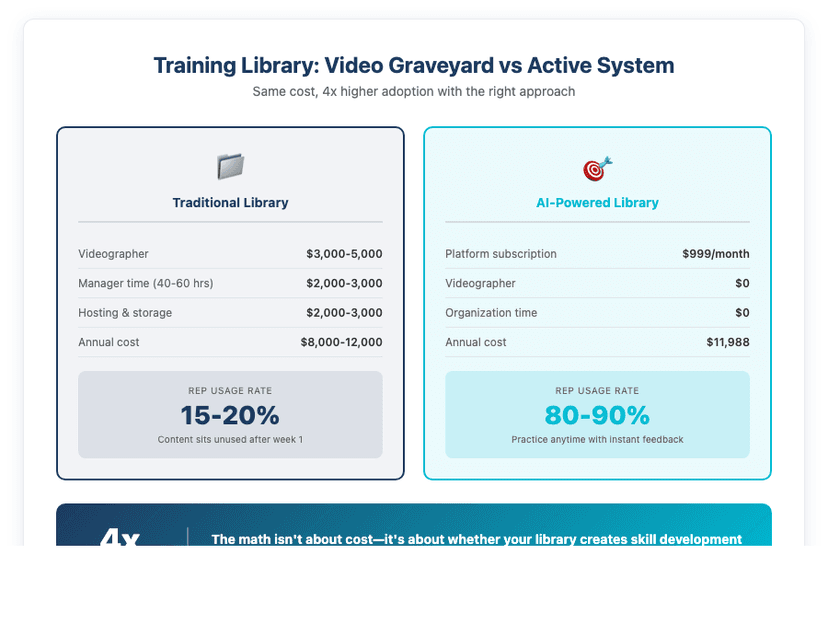
- $3,000-5,000 hiring a videographer to record your top reps
- 40-60 hours of manager time organizing and categorizing content
- $2,000-3,000 annually for video hosting and file storage
- Ongoing maintenance time (2-3 hours monthly minimum)
Total first-year cost: $8,000-12,000 for a library that 15-20% of reps actually use consistently.
AI-powered approach with GhostRep:
- $999/month for teams up to 10 reps (includes AI Role Play, Objection Mastery, and Ghost Rep live coaching)
- Zero videographer costs - AI generates unlimited scenarios automatically
- Zero organization time - competency-based structure is built-in
- Automatic updates when you modify your pitch or add new objections
- 24/7 mobile access from any device
Annual cost: $11,988 for a system that generates 80-90% adoption because reps can practice anytime, anywhere, and get instant feedback.
The math isn't about cost comparison. It's about whether your library creates skill development or sits unused.
🎯 Implementation Timeline
Don't try to build everything at once. Here's the realistic 4-week rollout:
Week 1: Foundation Scenarios Only
Build 15-20 basic doorstep and qualification scenarios. New reps start here. Nobody moves to week 2 until they complete these and pass a mock appointment.
Week 2: Add Intermediate Objections
Add 25-30 multi-layer objection scenarios. Existing reps who already have basics mastered start here. New reps advance here after proving Foundation competency.
Week 3: Advanced Situations + Product Hub
Add rare/complex scenarios for experienced reps. Build your quick reference guides for in-field lookups. This is when your library becomes genuinely comprehensive.
Week 4: Live Debrief System
Start Friday debrief sessions. Document tough situations from the week. Add them to the library for future reference.
After week 4, you have a complete, usable training library that supports reps from day one through year three. Maintenance is just adding new debrief situations and updating manufacturer info quarterly.
📊 Measuring Library Effectiveness
How do you know if your library is working?
Wrong metrics:
- Number of videos watched
- Time spent in the system
- Content completion rates
Those measure engagement, not competency.
Right metrics:
- Close rate by competency level - Are Intermediate reps closing 8-10% higher than Foundation reps?
- Time to first close - Are new reps closing their first deal in 3-4 weeks instead of 8-12 weeks?
- Objection conversion - What % of "I need to think about it" appointments turn into closed deals after objection practice?
- Practice-to-performance correlation - Do reps who complete 40+ scenarios monthly close more than reps who complete 10-15?
If those numbers aren't improving, your library isn't working regardless of how much content it contains.
🎯 The Bottom Line
A training library isn't about how much content you accumulate. It's about whether reps develop measurable competencies that translate to closed deals.
Stop asking: "How many training videos do we have?"
Start asking: "How many practice conversations has each rep completed this month, and what's their close rate by competency level?"
The contractors who make that shift see 22-28% close rates across their teams. The ones still dumping videos into Google Drive stay stuck at 15-18%.
Your library should be a skill development system, not a content archive. Structure it around progressive competencies, make practice mandatory, connect it to real results, and watch your team's performance transform.
Ready to build a library that actually works? GhostRep gives you 1,000+ pre-built roofing scenarios organized by competency level, AI-generated practice with instant feedback, and mobile access so reps practice in their trucks, not just in training sessions. See how it works →
How many training scenarios should a new rep complete before going solo?
Minimum 50-75 scenarios covering doorstep qualification, basic objections, and presentation structure. Top-performing teams require 100+ scenarios plus passing a mock appointment with a manager before first solo.
What's the difference between a training library and video courses?
Training libraries focus on progressive skill development through practice scenarios, while video courses deliver information through passive consumption. Effective libraries include 80% practice opportunities and 20% instructional content.
How often should you update roofing sales training content?
Quarterly reviews are essential for manufacturer warranty updates, pricing adjustments, and insurance claim procedures. Additionally, conduct weekly debriefs to capture new objection patterns for immediate addition to your library.
Can you build a training library without recording your top reps?
Yes, through AI-generated scenarios that simulate real conversations. GhostRep's AI Role Play creates unlimited practice scenarios based on your market, manufacturers, and typical objections without needing video production.
What makes reps actually use training libraries consistently?
Three factors drive adoption: (1) Mandatory completion requirements tied to solo appointment authorization, (2) Public progress tracking via leaderboards showing practice volume by rep, (3) Visible correlation between practice quantity and close rates.
How do you measure if a training library is working?
Track close rate by competency level, time to first close for new reps, objection conversion rates, and practice-to-performance correlation. If Intermediate reps aren't closing 8-10% higher than Foundation reps, your library isn't developing competencies effectively.
About the Author
Tim Nussbeck
Founder & CEO of GhostRep
Two decades in roofing—knocking doors, running teams, training 1,000+ reps. Built GhostRep to give every rep access to the coaching top teams get.
The GhostRep Advantage
One Platform. Closed Loop System.
Every interaction makes your team better. AI that learns, adapts, and improves with every rep.
Hire
AI screens candidates
Train
1,000+ scenarios
Coach
Real-time guidance
Analyze
AI learns & improves
You Might Also Like
80% of roofing sales require 5+ follow-ups. 44% of reps give up after one. Here's the exact 7-touchpoint cadence that takes close rates from 18% to 40%.
Virtual roofing sales appointments aren't the future—they're the present. The pandemic forced the industry to adapt, and contractors who figured it out discovered something unexpected: virtual appointments can be just as effective as in-person visits, with one massive advantage—you can do three times as many in a day. But here's what most guides won't tell you: there's a right way and a wrong way to sell roofing virtually. Get it wrong, and homeowners feel like they're watching a bad YouTube vi
Your top rep closes 180 deals at 36% and makes $280K. Then you send him to upscale territory and he closes 2 out of 23. The problem isn't the leads—it's that he's optimized responses for one demographic and can't adapt.