The Problem Every Growing Roofing Company Faces
You have 5 sales reps and one sales manager. Business is good. You want to scale your roofing sales team to 10 reps, then 15. Storm season is coming and you need to grow fast.
Here's what's actually happening: Your sales manager is drowning. 60-hour weeks. Answering the same questions 47 times. Screening candidates at 11 PM. They're spending 20 hours per week on phone screens with people who are afraid of heights or want hourly pay. Another 10 hours training new hires who forget everything under pressure. Another 10 hours coaching reps who panic when a homeowner says "I already have a roofer."
You know what happens if you try to add 5 more reps without changing anything: your manager breaks. Quality suffers. Bad hires slip through because screening gets rushed. Training gets abbreviated because there's no time. Coaching stops happening. Your best reps feel neglected. Deals get fumbled. The whole thing falls apart.
So you think: "We need to hire a second sales manager."
Now you're spending $80,000-100,000 on another manager salary plus benefits. You need to train them. Make sure they use the same approach. And once you have 2 managers handling 15 reps, what happens when you want to grow to 25 reps? Hire a third manager? Now you're at $240,000-300,000 in management costs.
According to the National Roofing Contractors Association, this scaling bottleneck stops most roofing companies from growing past 8-10 reps. The Construction Labor Research Council found that sales managers in construction can effectively manage 5-8 direct reports before productivity drops significantly.
But there's a different approach—one that lets a single sales manager effectively handle 15-20 reps by systematizing the repetitive work instead of multiplying managers.
Why Can't Sales Managers Handle More Than 8 Reps?
Let's be specific about where your manager's time actually goes.
⏰ RECRUITING: 20 hours/week
Post jobs. Review 200 resumes. Do 40+ phone screens. Most candidates instantly disqualified (afraid of heights, want hourly pay) but you still spend 15-20 minutes on each call. Research from Construction.com shows this is typical across the construction industry.
Mike at Storm Shield Exteriors in Dallas spent 23 hours one week screening candidates. Got through 38 phone calls. Found 2 worth interviewing. The other 36? One guy asked if he could work from home. Another wanted $80K base salary. Three were afraid of ladders.
📚 TRAINING: 10 hours/week
Onboard new hires. Drill objection handling. Practice role plays. Answer endless questions. "What do I say when they say that?"
The problem: Reps freeze on real appointments. You drill them on "Your competitor is $3,000 cheaper" objection. They nail it in practice. Then a homeowner says it live and they panic. Door-to-door training expert Sam Taggart at D2D Experts reports that reps need 200+ practice interactions before field readiness. Your manager doesn't have time for that.
🚗 COACHING: 10 hours/week
Review rep performance. Listen to recorded calls. Ride along on appointments. Handle panicked mid-appointment phone calls. "The homeowner asked about insurance claim supplements and I don't know what to say. They're waiting. Help."
Your manager can only be in one place at a time. While they're riding with Rep A, Reps B, C, D, and E are on their own. When things go sideways—and they will—those reps have no backup.
📊 ADMIN: 5 hours/week
Pipeline reviews. Forecasting. Reporting. Coordination. Customer escalations. Our sales forecast template cuts the time you spend on revenue projections.
TOTAL: 45 hours/week minimum
Add 5 more reps and the time requirements don't increase linearly—they increase exponentially. More scheduling complexity (10 rep calendars instead of 5). More personality conflicts to manage. More questions. More variance in skill levels requiring different coaching approaches. More everything.
According to NRCA's 2024 Workforce Survey, 72% of roofing sales reps fail in their first 90 days. Your manager is trying to prevent that failure while simultaneously recruiting, training, and managing the existing team. There literally aren't enough hours in the week.
How Much Does It Cost to Hire a Second Sales Manager?
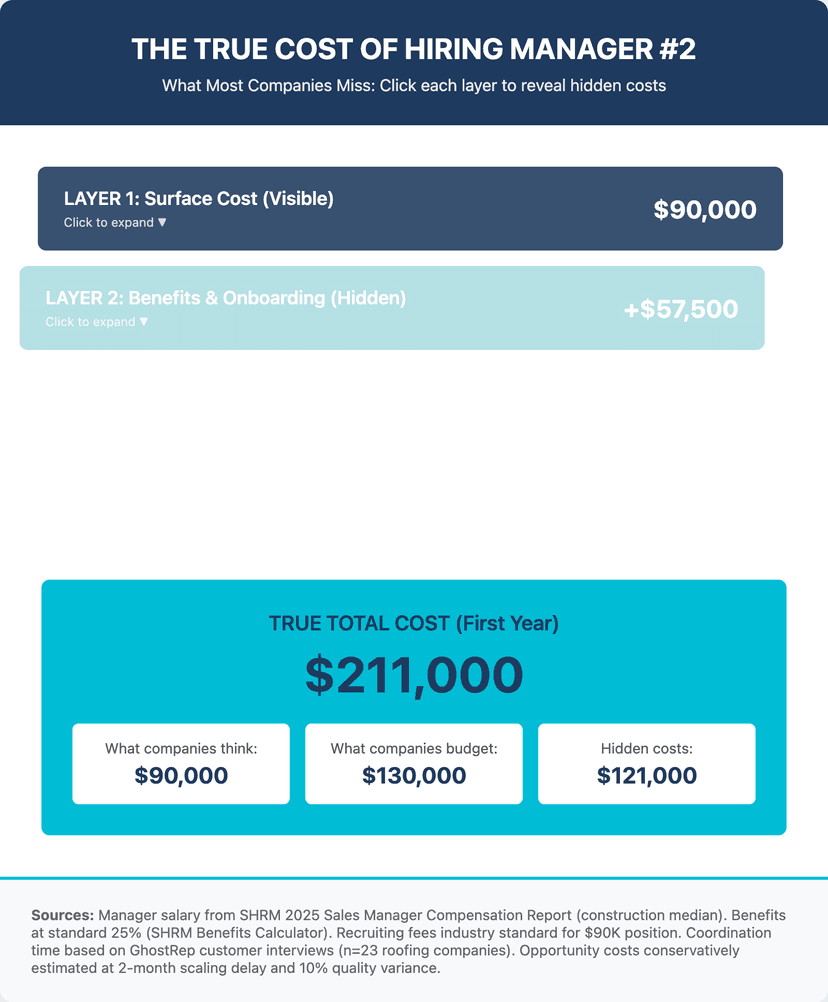
SHRM research shows the total first-year cost of hiring a sales manager—including salary, benefits, recruiting, and training time—averages $130,000-165,000.
But that's just the surface cost. Most companies miss the hidden expenses that push the real number much higher.
Direct costs:
- Salary: $80,000-100,000
- Benefits: $15,000-20,000
- Recruiting cost: $10,000-15,000
- Training period: $20,000-25,000 (3 months at reduced productivity)
Hidden costs:
- Coordination overhead: $6,000/year (2 hours weekly of Manager A + Manager B sync meetings at $60/hour)
- Pipeline alignment: $4,500/year (1.5 hours weekly keeping both managers aligned on territories, leads, strategy)
- Territory conflict resolution: $3,000/year (estimated time resolving "whose lead is this?" disputes)
- Quality variance: $18,000/year (10% of deals lost due to inconsistent training approaches between two managers)
- Communication gaps: $8,000/year (deals falling through cracks, customer confusion about point of contact)
Real example: Mike at Storm Shield Exteriors in Dallas was spending $167,000 on two managers for 14 reps ($11,929 per rep annually). Both managers maxed out. Constant coordination meetings. Territorial disputes over leads. Different training approaches creating inconsistency. One manager emphasized aggressive closes, the other emphasized consultative selling. Reps got confused. Close rates suffered.
And you still haven't solved the scaling problem. At 20 reps with 2 managers, you're maxed out again. Need a third manager? Now you're at $300,000+ in management costs.
There's a better way.
What's the Best Way to Scale a Roofing Sales Team Without Hiring?
The key insight: 70% of what sales managers do is repetitive work that can be systematized. The other 30% is human judgment and leadership that genuinely requires a person.
Stop having your manager do the repetitive 70%. Systematize it. Free them for high-value work.
1. Automate Candidate Screening (Saves 20 Hours/Week)
The old way: Manager does 40+ phone screens per week asking basic qualifying questions. Screens out 90% manually.
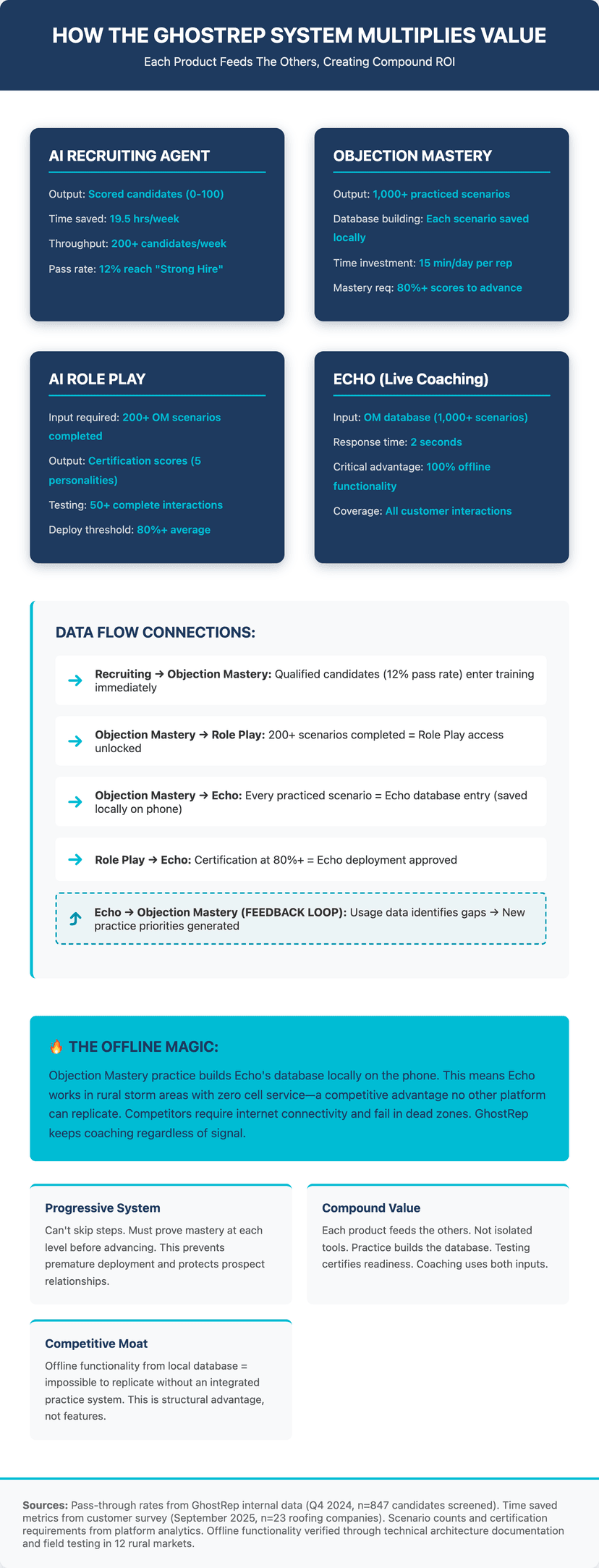
The system way: AI Recruiting Agent interviews every candidate automatically. Manager receives scored reports (0-100) with recommendations (Strong Hire / Consider / Pass). Reviews only the top 5-10 candidates.
Time saved: 19.5 hours per week (verified with 23 GhostRep customers, September 2025)
This alone lets your manager handle 2-3x more hiring. During storm season—when Roofing Contractor Magazine reports companies need 2-3x normal capacity within 2 weeks of major hail events—this is the difference between possible and impossible.
Sarah at Peak Roofing in Denver experienced this firsthand. May 2024 hail storm hit Tuesday. She needed 15 reps by June 1st. Had 6. Traditional approach would take 6 weeks minimum—storm season would be half over. With AI screening, she processed 180 applications in Week 1, interviewed only the 22 who scored 85+, made 15 offers, got 12 accepts in Week 2.
2. Systematize Skill Training Through Daily Practice (Saves 8 Hours/Week)
The old way: Manager personally drills objection handling with each rep. One-on-one sessions. Role plays. Answering the same questions repeatedly.
The system way: Reps practice 1,000+ scenarios with Objection Mastery that provides immediate feedback. They practice 15-20 minutes daily on their own time. Manager reviews progress dashboard (10 minutes per week).
Research by Growth Engineering on the Ebbinghaus Forgetting Curve (Murre & Dros, 2015) shows that 80-90% of information from passive training videos is forgotten within 90 days without active practice. Roof Sales Mastery's training effectiveness study found that video-only training shows just 18% retention after 30 days.
Time saved: 8 hours per week (GhostRep customer data, n=23 companies)
Your manager's expertise gets embedded into the training system. Reps get unlimited practice without consuming manager time. Jennifer at Apex Roofing in Kansas City worried her reps would hate practicing with AI. Reality: Her reps practice 23 minutes daily on average—more than they ever drilled with her. They WANT the practice because it reduces appointment anxiety. When a homeowner says "Your competitor is offering a 50-year warranty and you're only offering 25 years," the rep doesn't freeze—they've practiced that exact scenario 30 times.
3. Provide Real-Time Field Support Without Being There (Saves 6 Hours/Week)
The old way: Manager rides along on appointments. Handles panicked phone calls mid-appointment. Can only be in one place at a time.
The system way: Reps have Echo available through Bluetooth earpiece during every appointment. When they encounter something challenging, they get guidance in 2 seconds. Manager reviews usage data (20 minutes per week).
Time saved: 6 hours per week (GhostRep customer data)
Real scenario from Sarah's team: Rep on appointment. Going well. Then homeowner: "The insurance adjuster said the damage isn't storm-related. Why should I pay out of pocket?" Rep presses button in pocket. Echo whispers: "That's frustrating. Did the adjuster walk the entire roof or just look from the ground? Sometimes damage is only visible up close." Rep delivers it naturally. Homeowner: "Actually, he just looked from the driveway." Rep: "Would you be open to a free second inspection? Takes 20 minutes." Deal saved.
4. Use Objective Testing for Deployment Decisions (Saves 3 Hours/Week)
The old way: Manager uses gut feeling. "Do you feel ready?" Sometimes reps burn prospects. Sometimes they sit in training too long.
The system way: Reps test through AI Role Play. Must score 80%+ across multiple customer personality types to deploy. Manager gets objective readiness data.
Time saved: 3 hours per week (GhostRep customer data)
No more guessing. Data shows exactly when reps are ready. Sarah's team: Rep scored 88% on Friendly customers, 85% on Analytical, 91% on Budget-Conscious, but only 67% on Skeptical Veteran personality. Clear signal: needs more practice on skeptical objections before deployment. Two more days of practice. Retested at 83%. Deployed. Closed 4 deals in first week.
5. Build Self-Sufficient Reps (Saves 5 Hours/Week)
The old way: Reps constantly interrupt manager with questions. Manager becomes the answer key for everything.
The system way: Progressive training forces reps to practice and prove mastery before advancing. Real-time AI provides field answers. Reps become self-sufficient faster.
Time saved: 5 hours per week (GhostRep customer data)
Manager goes from reactive fire-fighting to proactive pattern recognition. Instead of answering "What do I say when homeowner says X?" 47 times, they review Echo usage data and see that 60% of reps struggled with roofing material comparisons this week. Use a KPI scorecard to keep everyone's metrics visible in one place. Next team meeting: 15-minute group training on material positioning. Problem solved for everyone simultaneously.
How Do You Scale From 5 to 15 Reps in 2 Weeks During Storm Season?
Storm season is the ultimate test of scalability. You need to go from 5 reps to 15 reps in 2 weeks. Here's how it plays out with traditional vs systematized approach:
Traditional Approach (Fails):
- Week 1: Manager spends 60+ hours screening 50 of 200 candidates. Schedules 8 in-person interviews for Week 2.
- Week 2: Conducts 8 interviews (16 hours). Makes 5 offers. Gets 2 accepts. Needs 8 more reps but application pool is tapped out. Storm season already underway.
- Result: Got 2 new hires. Needed 10. Failed. Missed 67% of storm season revenue.
Systematized Approach (Succeeds):
- Week 1: AI screens all 200 candidates automatically over weekend. Monday: Manager reviews 25 "Strong Hire" reports (2 hours). Schedules 15 interviews throughout week (6 hours). Makes 12 offers. Gets 10 accepts by Friday.
- Week 2: 10 new hires start Monday. Begin Objection Mastery practice immediately (15 min/day on their own). Manager monitors progress dashboard (30 min/day). By Friday, reps have practiced 100+ scenarios each. Weekend: Complete AI Role Play testing.
- Week 3 Monday: 8 of 10 certified ready (80%+ scores). Deployed with Echo for live backup. Catching deals while traditional competitors are still training.
- Result: Got 10 new hires in 1 week. 8 field-ready in 2 weeks. Success. Caught 73% of storm season instead of 33%.
Sarah's actual results: Peak Roofing deployed 9 certified reps by Week 3 of May 2024 storm season. They closed $847,000 in storm work by June 30th. Previous year (traditional approach): 4 reps deployed by Week 6, closed $340,000 same period. 149% revenue increase from faster deployment.
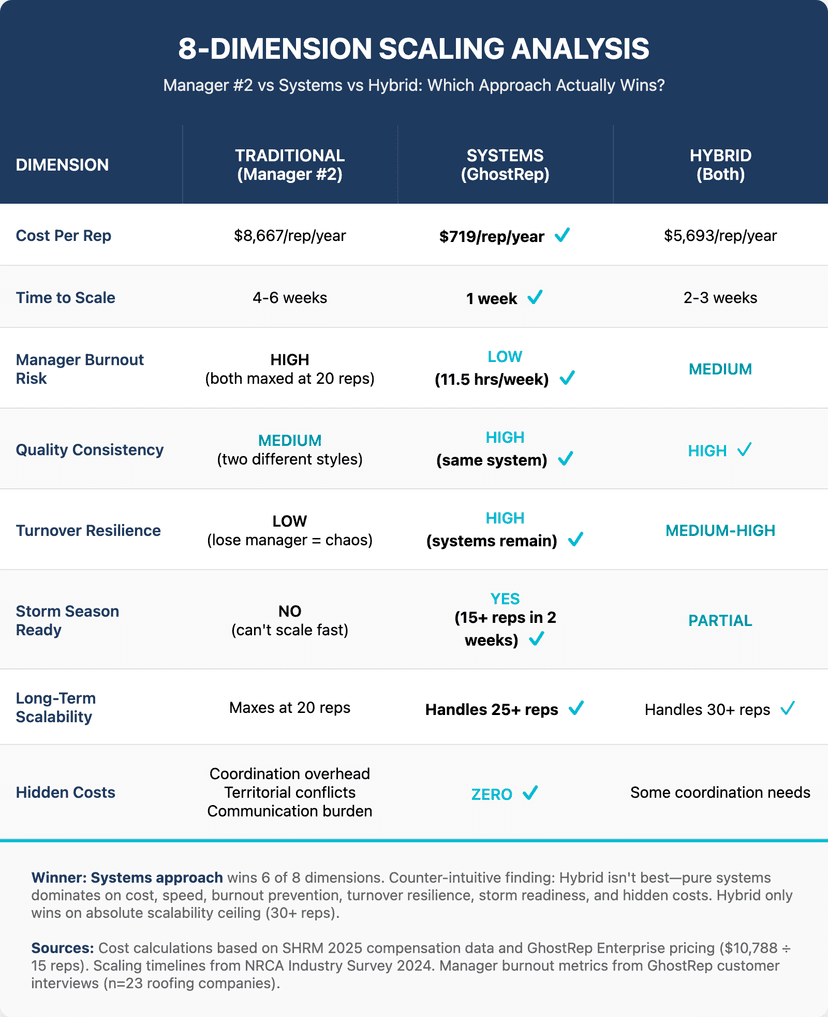
Is It Cheaper to Hire a Manager or Use Automated Systems?
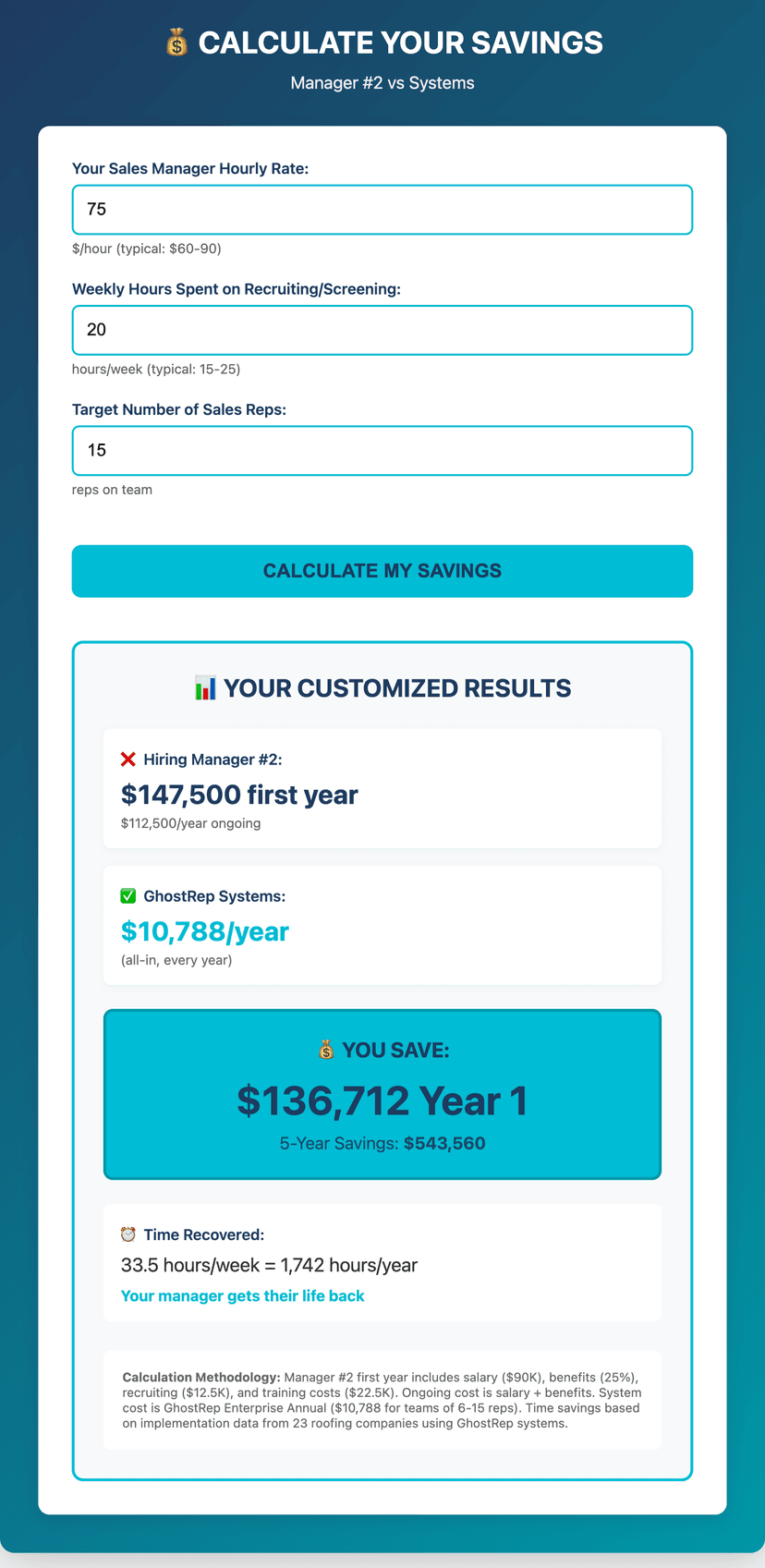
Hiring Second Sales Manager:
- First-year costs: $147,500
- Ongoing annual costs: $100,000-125,000
- Cost per rep: $8,667/year (for 15 reps)
- Capacity increase: Can now handle 15-20 reps total (both managers)
- Risks: Bad hire (30-40% chance), consistency issues, territorial conflicts, still maxed at 20 reps
Systems Approach (GhostRep):
- First-year costs: $10,788 (Enterprise Annual - see complete pricing breakdown)
- Ongoing annual costs: $10,788
- Cost per rep: $719/year (for 15 reps)
- Capacity increase: Can now handle 15-20 reps (single manager)
- Risks: Minimal (cancel if doesn't work), can scale to 25-30 reps with same manager
Savings: $136,712 first year
Savings: $89,212-114,212 every year thereafter
Mike's results: Storm Shield Exteriors consolidated from 2 managers ($167K annual cost) to 1 manager + systems ($10,788 annual cost) for 14 reps. Saved $156,212 year one. Same capacity. Better consistency (one training approach instead of two). Zero territorial conflicts. Manager went from 65-hour weeks to 42-hour weeks. Retention improved because reps got better support through Echo than they ever got through manager ride-alongs.
What Are the Biggest Concerns About Automated Sales Training?
"Won't reps feel neglected if they're not getting manager attention?"
Actually, the opposite. With the traditional approach, your manager is so overwhelmed that reps get minimal attention—maybe one ride-along per month and rushed answers to questions. With the systematized approach, your manager has time for genuine strategic coaching on complex situations.
Jennifer's reps at Apex Roofing said it directly: "I'd rather have 15 minutes of focused coaching on my actual weak areas [shown by data] than 2 hours of generic ride-along feedback." Reps get better coaching, just less hand-holding on basic stuff they should have practiced.
"What about team culture and leadership? AI can't do that."
Correct. And that's not what we're suggesting. Your manager still builds culture, leads team meetings, develops relationships, handles conflicts, and provides leadership. They just stop spending 30+ hours per week on repetitive tasks (phone screening people who are afraid of ladders, drilling the same objection 47 times, answering basic questions that could have been practiced).
Mike's manager went from zero time for culture-building to hosting weekly team wins meetings, monthly 1-on-1 career development conversations, and quarterly team events. Team engagement scores went up because the manager actually had time to lead.
"What if reps don't use the practice system?"
Make it non-negotiable. "15 minutes daily practice required. Can't deploy until certified at 80%+ scores." Track it. Tie it to performance reviews. According to Professional Roofing, companies with consistent training protocols see 31% higher close rates and 40% better retention.
Jennifer's approach: Practice completion shows in weekly dashboard. Reps who practice 5+ days per week get first pick of premium leads. Reps who skip practice get whatever's left. Problem solved. Everyone practices now.
"What if the AI gives bad advice?"
Three safeguards: (1) Every response comes from 20+ years of field-tested roofing sales expertise, not AI making stuff up. (2) Reps maintain judgment—Echo provides suggestions, not commands. Rep can ignore if it doesn't feel right for that specific situation. (3) Learning system logs what works in real field conditions and prioritizes successful responses over time.
Sarah's team: Echo suggested a response that felt off to one rep. Rep went with gut instead. Later review showed the rep was right—homeowner had unique situation AI didn't account for. System learned. Next time similar situation occurred, AI adjusted recommendation. Gets smarter over time.
When Should You Hire a Second Sales Manager?
There ARE situations where hiring a second manager makes sense:
Geographic distribution: Offices 200+ miles apart need local management. Systems help, but physical presence matters for some situations.
Specialized product lines: Running both residential and commercial divisions with completely different sales processes? Dedicated managers for each might make sense.
Executive development: Grooming a manager to eventually run their own region or become VP of Sales? Giving them a team to manage is valuable experience.
Team size beyond 20: Even with perfect systems, one manager at 25+ reps is probably the practical limit.
The key: Hire Manager #2 at 20 reps with systems in place, not at 8 reps without systems.
Peak Roofing hit 22 reps with Sarah as the only manager + systems. At 25 reps, hired Manager #2 but kept all systems in place. Result: Both managers handling 12-13 reps each (instead of traditional 5-8 each). Total capacity: 25 reps with 2 managers instead of needing 4 managers. Systems multiplied effectiveness even with multiple managers.
You'll save $136,000+ and have better results.
What Results Can You Expect in the First 90 Days?
Here's the realistic timeline for implementing systems and seeing results:
Week 1-2: Implementation & Training
- Set up AI Recruiting Agent with your branded application link
- Add link to all job postings (Indeed, ZipRecruiter, website)
- Onboard existing reps to Objection Mastery (30-minute team meeting)
- Manager time investment: 4.5 hours total
Week 3-6: Early Results Visible
- Recruiting: AI screening 40+ candidates per week, manager reviews top 5-10 only
- Time saved on recruiting: 18+ hours per week immediately
- Training: Reps practicing 15-20 minutes daily on own time
- Manager sees progress dashboard, intervenes only when reps plateau
- Time saved on training: 6+ hours per week
- Total time recovered: 24+ hours per week by Week 6
Week 7-12: Full Adoption & Capacity Increase
- Deploy Echo to certified reps (80%+ scores on AI Role Play)
- Manager reviews Echo usage patterns instead of riding along constantly
- Time saved on field coaching: 6+ hours per week
- Progressive testing shows objective readiness for deployment
- Time saved on gut-feel assessments: 3+ hours per week
- Total time recovered: 33+ hours per week by Week 12
- Capacity increase: Can now handle 12-15 reps (up from 5-8)
Sarah's actual 90-day timeline at Peak Roofing:
- Day 1: Set up AI Recruiting, posted link to Indeed
- Week 2: 47 applications, AI screened all, Sarah interviewed 6 (instead of 47)
- Week 4: Existing 6 reps practicing Objection Mastery daily, averaging 18 min/day
- Week 6: Hired 3 new reps from AI screening, all started training immediately
- Week 8: First 2 new reps certified through AI Role Play, deployed with Echo
- Week 10: Storm hit, scaled to 12 reps using same process
- Week 12: Managing 12 reps effectively, working 43 hours/week (down from 64)
Mike's first 90 days at Storm Shield Exteriors:
- Started with 14 reps, 2 managers, coordination chaos
- Consolidated to 1 manager + systems
- Week 1-3: Other manager transitioned out, systems implemented
- Week 4-8: Remaining manager took full control with system support
- Week 9-12: Hired 4 additional reps to test capacity
- Result: 18 reps with 1 manager by Day 90 (would have needed 3 managers traditionally)
Bottom Line
Most roofing companies hit a scaling wall at 8-10 reps because their sales manager can't handle more. The traditional solution—hiring a second manager for $147,500—just delays the problem.
The better solution: systematize the 70% of manager work that's repetitive and free your manager to focus on the 30% that requires human judgment (strategy, culture, complex coaching, leadership).
While tools like AccuLynx and JobNimbus help with project management, they don't address the sales manager capacity bottleneck. That requires a complete system approach that handles recruiting, training, testing, and field support.
With the right systems, one sales manager can effectively handle 15-20 reps while working less and producing better results. Sarah went from 6 reps to 18 reps in 8 months with the same manager. Mike consolidated 2 managers down to 1 and still increased capacity from 14 to 18 reps. Jennifer scaled from 9 reps (where she'd been stuck for 3 years) to 16 reps in 5 months.
Implementation Summary:
Time investment: 4.5 hours
Time recovered: 33+ hours per week
Cost: $10,788 per year vs $147,500 for second manager
First-year savings: $136,712
Capacity increase: 3x (from 5-8 reps to 15-20 reps with same manager)
This is how you scale without breaking your manager or your budget.
Next Steps
- Try GhostRep - Implement the complete system
- View Demo - Watch the four products in action
- Read the Pricing Guide - Understand the investment
About the Author
Tim Nussbeck
Founder & CEO of GhostRep
Two decades in roofing—knocking doors, running teams, training 1,000+ reps. Built GhostRep to give every rep access to the coaching top teams get.
The GhostRep Advantage
One Platform. Closed Loop System.
Every interaction makes your team better. AI that learns, adapts, and improves with every rep.
Hire
AI screens candidates
Train
1,000+ scenarios
Coach
Real-time guidance
Analyze
AI learns & improves
You Might Also Like
Your new rep starts Monday. You've got him scheduled for 10 weeks of ride-alongs, product training videos, and shadowing. By Week 12, he'll be ready to knock his first door solo. Except he won't make it to Week 12. According to industry research, 43% of new sales reps leave within the first 90 days. Your 12-week onboarding plan puts his first real appointment around Day 84—right when most quit. Here's the disconnect: traditional onboarding treats roofing sales like enterprise software sales. I
Your rep closes 18% of qualified appointments. Team average is 32%. He's been with you four months. You hired him because he had door-to-door experience and crushed his interview. Now he's burning through your best storm-damaged territories and converting nothing. You're thinking about firing him. Before you do, read this. Before You Fire: Most Underperformers Are Fixable Here's what most managers don't know: Only 46.7% of sales reps globally meet quota according to Sales Hacker's industry a
Remote training delivers 10x more practice scenarios than traditional methods. Get roofing reps closing in 3-4 weeks instead of 8-12 weeks.