Storm season reps quit for one reason: they run out of money before they see a paycheck.
Not because of complicated training. Not because they don't believe in the business model. Not because of trust issues or insufficient ride-alongs. They quit because they need cash in their pocket, and your training program isn't getting them there fast enough.
Every day a new hire spends in "training" instead of knocking doors is another day without income. Every week they spend shadowing experienced reps instead of booking their own appointments pushes their first commission check further away. By the time they're "fully trained" according to your manual, they've already left for a job that pays weekly.
The roofing companies that win at storm season hiring understand this. They stop obsessing over comprehensive training programs and start focusing on one metric that actually matters: how fast can you get a new hire to their first paycheck?
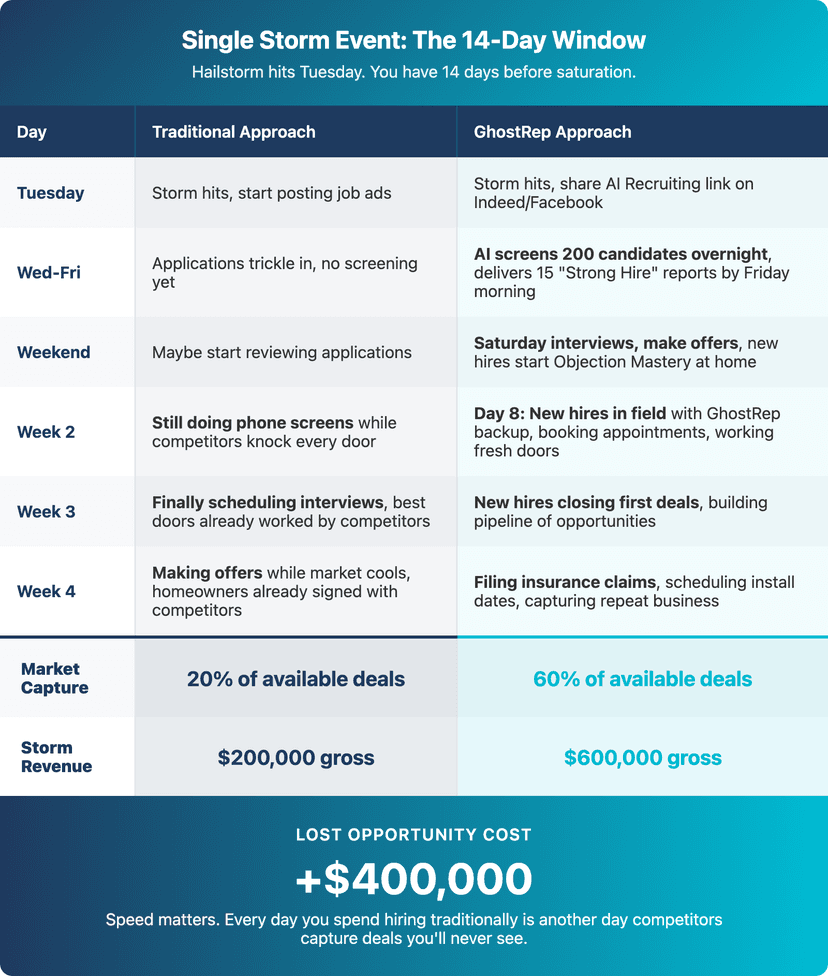
According to the National Roofing Contractors Association's storm damage research, storm season creates concentrated demand spikes where 70-80% of insurance claims get filed within the first two weeks after a hailstorm. Your new hires need to be generating appointments and closing deals in that window, not sitting in a classroom learning about company values.
What Does a Storm Season Rep Actually Need to Know?
A sales rep after a storm needs to be able to do four things:
Knock a door and set an appointment - Get in front of homeowners and book inspections
Climb a roof safely and inspect for damage - Identify hail hits on GAF Timberline shingles, document impact points on ridge caps, photograph evidence for insurance adjusters
Pitch a customer correctly - Close at the kitchen table or get commitment to move forward with insurance claim
Meet an adjuster - Show up prepared and fight for proper scope on supplements
That's it. Everything else is noise that delays their first paycheck.
Here's the breakthrough: only one of these four skills needs formal training before they hit the field. The other three have to be learned while they're already working, because you can't practice roof inspections in a classroom and you can't learn to handle adjusters by watching videos.
Why Door Knocking Is the Real Bottleneck
Door knocking is what stops most new hires from ever getting to their first appointment. They freeze up at doors. They fumble the opening. They don't know how to handle "not interested" or "I already have a roofer." They burn through 50 houses before booking their first inspection, get discouraged, and quit before ever seeing money.
Traditional training tries to solve this with role-playing. Your sales manager pretends to be a homeowner, the new hire practices their pitch, and everyone feels good about the "training" that just happened. Then the new hire knocks their first real door, the homeowner doesn't follow the script, and everything falls apart.
This is where technology like GhostRep's Objection Mastery changes the game. It's an AI-powered training platform that lets new hires practice hundreds of door knocking scenarios on their phone before ever approaching a real house. The AI homeowner reacts dynamically to what they say—gets hostile when they fumble, warms up when they nail the opening, throws realistic objections.
New hires can drill door knocking at home, on their couch, at midnight if they want. They practice 50, 100, 200 door scenarios before knocking their first real door. By the time they hit the field, they've already heard every objection and know the responses. The door approach that took your experienced rep three months to master, new hires can learn in a week of practice.
This matters because it compresses the timeline to first appointment. Instead of burning 50 real doors learning on the job, they show up day one ready to book inspections. That means appointments by day 2-3, which means potential deals by day 5-7, which means a path to their first paycheck is visible instead of theoretical.
How to Train the Other Three Skills in the Field
You cannot teach roof inspection safety in a classroom. You cannot teach damage identification from photos. You cannot teach how to handle a skeptical adjuster through role-play.
These skills require actual roofs, actual damage, and actual adjusters. Which means your new hire needs to be in the field learning these while simultaneously generating revenue.
Roof Inspection Training (Days 1-3)
Day one should be safety and supervised climbs. According to OSHA's construction fall prevention guidelines, falls are the leading cause of death in construction. Your new hire needs proper ladder training, fall protection equipment, and clear protocols for steep or damaged roofs before they climb anything unsupervised.
This isn't negotiable. Half a day on ladder safety, proper equipment, three-point contact, when to refuse a dangerous roof. Then they shadow an experienced inspector on 5-10 roofs. They're not inspecting yet—they're watching where to step on Owens Corning Duration shingles, how to spot hail damage on CertainTeed Landmark, what to photograph, how to document granule loss.
By day three, they're doing supervised inspections. The experienced inspector climbs with them, watches their technique, corrects mistakes in real-time. They complete 10-15 inspections over two days while still generating value for the company—those inspections still go to homeowners, still create potential deals.
By day four or five, they're ready for solo inspections on easy roofs. They're not experts yet, but they're competent enough to identify obvious damage and document it properly. The company now has another person generating appointments instead of sitting in training.
Kitchen Table Close Training (Days 1-7)
Most companies waste massive time pulling new hires out of the field for multi-day sales training boot camps. Meanwhile, appointments they could be running are going to competitors.
The better approach: let them shadow 3-5 kitchen table closes with an experienced closer, then start running their own with backup available. They'll fumble some. They'll miss buying signals. They'll blow presentations. That's fine—they're learning while generating potential revenue.
GhostRep's AI Role Play lets reps practice complete 15-20 minute kitchen table scenarios with AI customers before sitting down with real homeowners. The AI customer reacts dynamically to pricing fumbles, handles skeptical objections about insurance deductibles, forces the rep to adapt when homeowners say "I need to talk to my spouse."
After practicing 20-30 complete closes with AI, reps show up to real appointments with pattern recognition already built. But this practice happens on the rep's own time, at home, not pulling them out of the field. During working hours, they're running appointments and learning from real interactions.
Adjuster Meeting Training (Week 2+)
Most companies don't even prepare new reps for adjuster meetings. The rep books the inspection, gets the homeowner excited, the adjuster shows up, the rep stands there silent while the adjuster slashes the estimate, and the deal dies.
This skill is critical because it's where reps either make or lose $3,000-8,000 per deal. According to Insurance Journal's claims supplement analysis, proper supplement negotiation can recover 15-25% more on insurance claims. A rep who doesn't know how to fight for proper scope on wind damage leaves thousands on the table.
The training for this is simple: shadow 2-3 adjuster meetings with your best supplement fighter, then start attending your own with backup available by phone. When the adjuster makes a move they haven't seen before—claims wind damage is "wear and tear" or denies ridge cap replacement—they text the experienced rep who coaches them through it.
The Real Onboarding Timeline: Getting to First Paycheck
Here's what rapid storm season onboarding actually looks like when you focus on speed to first commission:
Days 1-2: Door Knocking Readiness
- New hire spends 8-12 hours practicing door scenarios on Objection Mastery at home
- Completes safety training and equipment check
- Shadows experienced rep for half day seeing real door approaches
- Result: Ready to knock doors independently by day 3
Days 3-5: First Appointments Booked
- Knocking doors in storm-affected neighborhoods
- Books first 5-10 inspections
- Shadows roof inspector on 3-5 roofs learning damage identification
- Result: Generating appointments, learning inspection skills simultaneously
Days 6-7: First Inspections Completed
- Completing supervised roof inspections
- Books additional appointments from door knocking
- Shadows 1-2 kitchen table closes
- Result: Building pipeline of potential deals
Week 2: First Deals Closed
- Running own kitchen table presentations with GhostRep's live coaching backup available
- Completing inspections independently on straightforward roofs
- First contracts signed
- Result: Path to first commission check is now concrete
Week 3: First Paycheck Arrives
- Insurance claim filed and approved on first deals
- Rep sees money from their work
- Confidence skyrockets
- Result: Rep commits to the business because they've proven they can make money
This timeline assumes weekly or bi-weekly commission payments. If you're paying monthly, you've got a serious problem—new reps will quit before seeing a check.
Why Most Storm Season Hires Actually Quit
You can have perfect training, supportive culture, and clear processes. None of it matters if your new hire runs out of rent money before their first commission check.
Pure commission structures sound great in theory—you only pay for performance, costs are aligned with revenue. In practice, they create a death spiral for new hires. Week one, they're learning and generating minimal income. Week two, they're getting better but deals haven't closed yet. Week three, they're out of money and desperate. Week four, they take a job at Home Depot that pays weekly.
The roofing companies that successfully hire storm season help solve this with one of three approaches:
Option 1: Weekly Commission Payments Instead of monthly commission checks, pay out weekly on any deals that close. This gets money in new hires' pockets faster and keeps them motivated. They close a deal on Monday, they see money Friday. It's more administrative work for you, but it dramatically reduces early quit rates.
Option 2: Daily/Weekly Training Stipend Pay $100-200/day or $500-1,000/week for the first two weeks while they're ramping. This isn't salary—it's an advance against future commissions or a training stipend. It keeps them fed and housed while they're building their pipeline. Once they're closing deals, the stipend stops and they're on pure commission.
Option 3: Draw Against Commission Provide a weekly draw of $800-1,200 that they pay back from future commission checks. If they close a $10,000 deal and earn a $1,500 commission, they get $700 that week ($1,500 minus the $800 draw). If they don't close anything, they still get $800 to live on.
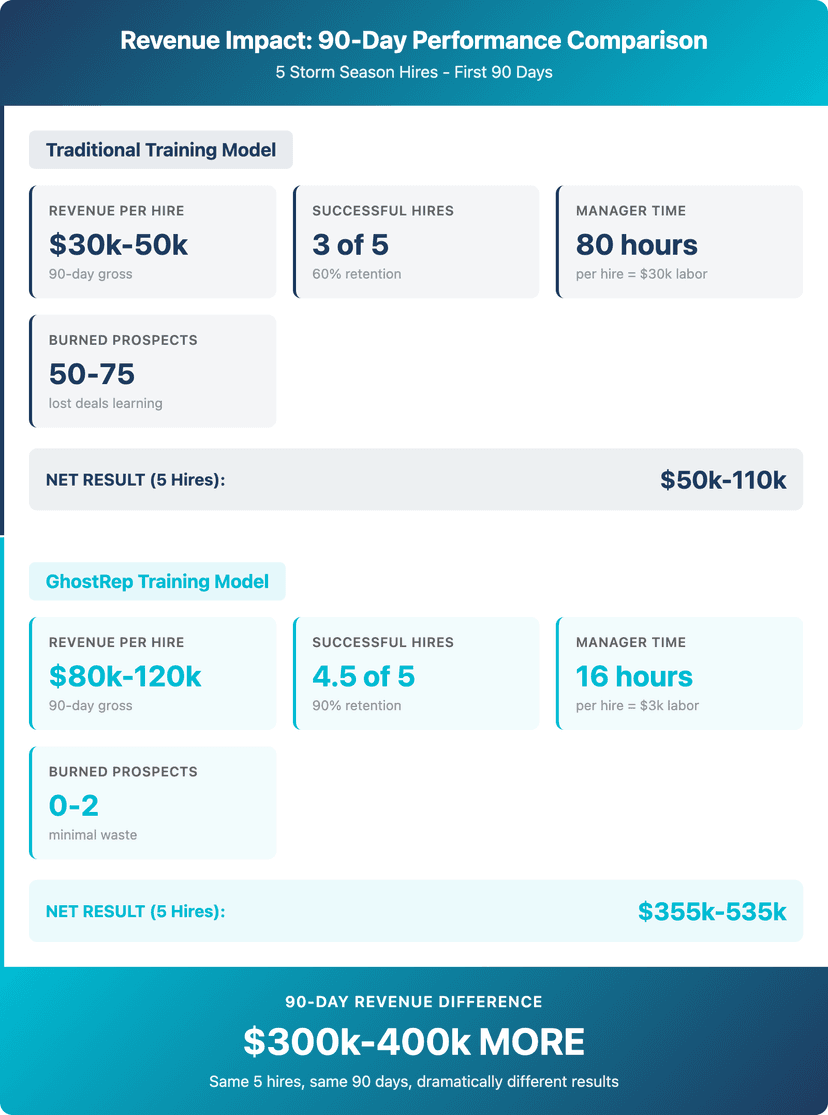
All three options cost you money upfront. But they're cheaper than constantly hiring and training new reps who quit before closing their first deal. According to Construction Business Owner's hiring cost analysis, the average cost of a bad hire in construction exceeds $50,000 when you factor in recruiting, training, and lost opportunity costs. Spending $2,000-4,000 to bridge a new hire through their first month is cheap insurance against that loss.
The Technology That Actually Matters for Storm Season
Most companies waste money on the wrong technology. They buy expensive CRMs, elaborate training platforms, and fancy measurement tools before solving the fundamental problem: getting new hires competent at door knocking and basic sales skills.
Here's what actually moves the needle:
AI Role-Play Training (Essential) GhostRep's Objection Mastery or similar AI training platforms that let reps practice hundreds of scenarios on their own time. This is the highest ROI technology investment you can make for storm season hiring because it solves the door knocking bottleneck that prevents new hires from ever getting to their first appointment.
New hires practice at home, on their schedule, without requiring your time. They get instant feedback on what worked and what didn't. They encounter customer personalities they'll see in the field. By the time they knock their first door, they've already practiced 100-200 door scenarios.
Live Coaching Tools (High Value) GhostRep's live coaching works via Bluetooth earpiece during live appointments. Rep gets stuck on an objection about insurance deductibles, presses a button, AI whispers the right response. Critically, it works offline—built-in database means it functions in rural areas with no cell service where other AI tools fail.
This technology is game-changing for storm season because it lets new reps work independently while still having backup when they encounter situations they haven't trained for. They're generating appointments and running closes without constant supervision, but they're not alone when a customer throws a curveball.
What Actually Kills Storm Season Hiring Programs
Based on watching hundreds of roofing companies hire for storm season, here are the actual failure modes:
Failure Mode 1: Trying to Clone Your Best Rep Your top closer has been in the industry for eight years. They know every objection, every adjuster trick, every Atlas shingle specification. You try to transfer all that knowledge to new hires before they hit the field.
This is impossible and delays deployment. Your new hire doesn't need to be your best rep on day one. They need to be 60% as good, which is enough to book appointments and close straightforward deals. The other 40% they develop over months of field experience.
Failure Mode 2: No Financial Bridge You hire someone on pure commission, they work hard for two weeks, they haven't seen any money yet, they quit and take a job that pays weekly. You blame them for "not being tough enough" or "not believing in the opportunity." The problem was never their belief—it was your payment structure.
Failure Mode 3: Leaving Them Alone Too Soon You give them three days of training, send them out solo, and assume they'll figure it out. They encounter situations they weren't prepared for—homeowner demands Malarkey shingles when your standard is GAF, adjuster claims pre-existing damage on obvious hail hits—fumble deals, get discouraged, quit. They needed more support during weeks 2-4, not more training before week 1.
The Uncomfortable Truth About Storm Season Success
The uncomfortable truth is that storm season success isn't about finding better people. It's about building better systems that make average people productive quickly.
Your competitor isn't hiring from a secret talent pool you don't have access to. They're not paying dramatically more than you. They're not offering better long-term career opportunities. They're just getting new hires to their first paycheck faster, which keeps them motivated and committed long enough to actually learn the business.
According to Roofing Contractor Magazine's 2024 labor report, labor shortages remain the top challenge for roofing contractors. The companies solving this aren't finding a magical source of better candidates—they're building better onboarding systems that turn average candidates into productive reps faster.
This isn't about lowering standards or accepting mediocrity. It's about understanding that competency develops through field experience, not classroom training. It's about using technology to compress the learning curve. It's about fixing payment structures that doom new hires before they have a chance to succeed.
The companies that figure this out will dominate storm seasons for years to come. The ones that don't will continue struggling to staff up when opportunity strikes, watching competitors capture market share with teams that materialized seemingly out of nowhere.
Frequently Asked Questions
How long does it take to train a storm season roofing sales rep?
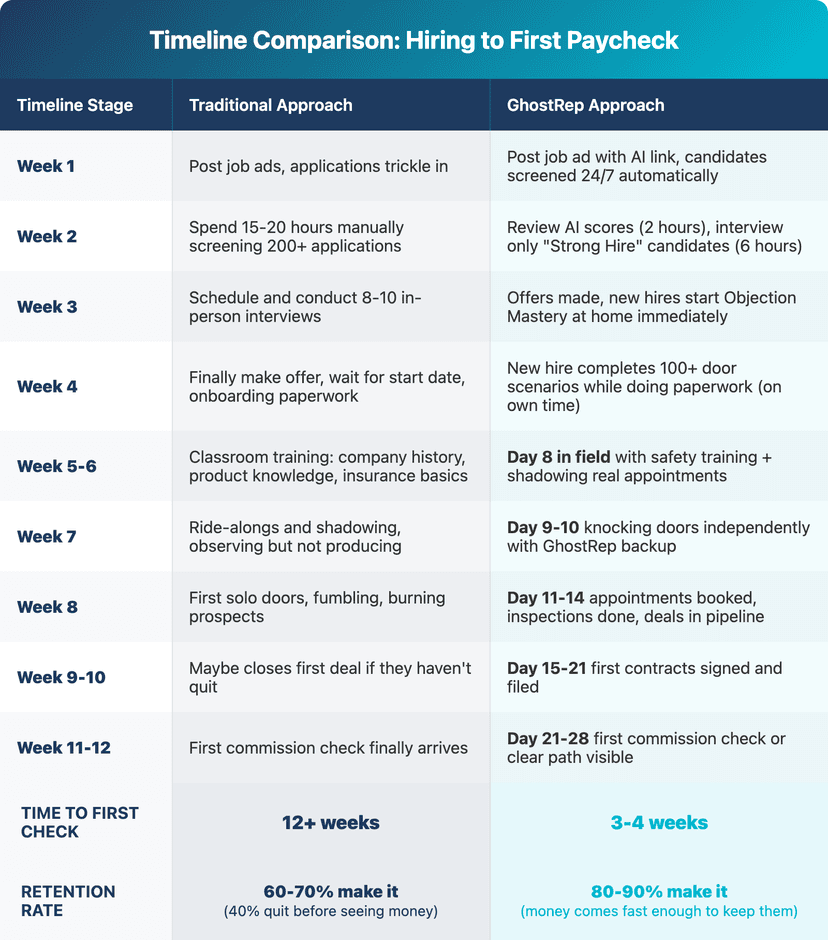
Traditional training takes 8-12 weeks from hire to first paycheck. AI-powered training with platforms like GhostRep compresses this to 3-4 weeks by enabling new hires to practice 100+ door scenarios and complete kitchen table closes before ever approaching a real house. The key difference is practicing on their own time at home versus pulling them out of the field for classroom training.
Why do most storm season reps quit before closing their first deal?
New hires quit because they run out of money before seeing a commission check. Traditional 8-12 week training timelines exceed most people's financial runway, causing 40% to leave for jobs with weekly pay. The solution is either weekly commission payments, training stipends of $500-1,000/week for the first two weeks, or draws against future commissions of $800-1,200/week.
What's the minimum training needed before sending reps to knock doors?
Reps need basic door knocking competency (100+ AI practice scenarios on platforms like Objection Mastery), safety training for roof climbs, and understanding of basic inspection protocols. This can be achieved in 3-4 days with AI training happening at home on the rep's own time. Then learning continues in the field with supervision for weeks 1-2.
How do you train new reps on adjuster meetings?
Have new reps shadow 2-3 adjuster meetings with your best supplement negotiator, then start attending their own with backup available by phone. The key is learning in real situations with support, not classroom training. GhostRep's Objection Mastery includes specific scenarios for adjuster meetings so reps can practice handling "pre-existing damage" claims and supplement negotiations before the real meeting.
What payment structure works best for storm season hiring?
Weekly commission payments work best because new hires see money within 7-14 days of their first closed deal instead of waiting 30-45 days. Alternative approaches include weekly training stipends of $500-1,000 for the first two weeks, or weekly draws of $800-1,200 against future commissions that reps pay back once they start closing consistently.
About the Author
Tim Nussbeck
Founder & CEO of GhostRep
Two decades in roofing—knocking doors, running teams, training 1,000+ reps. Built GhostRep to give every rep access to the coaching top teams get.
The GhostRep Advantage
One Platform. Closed Loop System.
Every interaction makes your team better. AI that learns, adapts, and improves with every rep.
Hire
AI screens candidates
Train
1,000+ scenarios
Coach
Real-time guidance
Analyze
AI learns & improves
You Might Also Like
Reps don't quit because they're not hungry—they quit because they don't get paid fast enough. 8-10 weeks to first check kills 60% of hires. Speed matters.
You posted a job 48 hours ago. You've got 127 applications. 83 of them are pure trash—people who've never sold anything, much less knocked a door or closed a $30,000 roof deal. Another 32 might be okay, but you have no idea which ones because reading 127 resumes would take you 6+ hours. Meanwhile, your two top reps just quit to start their own companies. Storm season starts in 3 weeks. You need bodies yesterday. This is why we just added three major updates to GhostRep's AI Recruiting System
Generic interview questions predict nothing. The 8 questions that actually matter probe for door-to-door rejection experience, commission volatility tolerance, and financial crisis response.