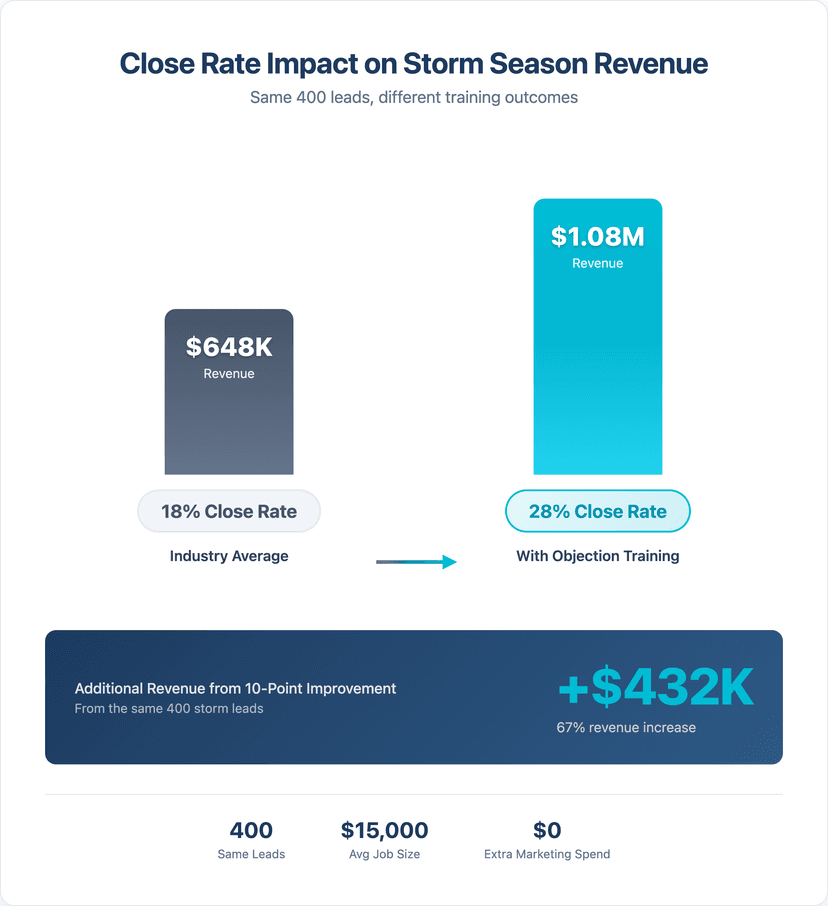
Storm season revenue calculators show roofing contractors lose $100,000-$200,000 annually from burned leads—not from bad marketing, but from training failures. The average contractor with 400 storm leads, an 18% close rate, and $15,000 average job size generates $648,000 in revenue. But here's the problem: 40% of those leads get burned before a single rep shows up at the door.
That's $180,000 in recoverable revenue walking away because your training system can't prepare reps for insurance objection complexity, speed-to-contact demands, and managed repair program negotiations. Use our calculator below to see exactly how much your current approach costs you every storm season.
How to Calculate Storm Season Revenue Loss for Roofing Contractors
According to industry data on roofing lead conversion rates, storm damage leads typically convert at 30-40% for top performers but only 10-20% for average contractors. That 20-point gap isn't about territory quality or lead generation effectiveness—it's about systematic training failures that get exposed when objection complexity intensifies during storm season.
Here's what actually burns storm leads: Your company generates 500 qualified opportunities. You assign them to your team. Half your reps can't handle the "my insurance company sent me a preferred contractor list" objection.
A third of leads sit for 48+ hours because nobody understands how to prioritize managed repair programs versus direct homeowner calls. Another chunk gets burned when your newest rep fumbles the "my adjuster said the damage doesn't warrant replacement" conversation for the fifteenth time.
By the time you recognize the pattern, 200 of those 500 leads are dead. Not because homeowners decided they don't need roofs. Because your training infrastructure failed to prepare reps for the velocity and complexity that storm restoration creates.
The calculator math reveals the actual cost: 400 leads at 18% close rate with $15,000 average job size generates $648,000. Reduce burned leads from 40% to 28% through better objection preparation. Increase close rate to 23% through pattern recognition training. Same lead volume. Same territory. Same marketing spend.
Result: $828,000 in storm season revenue—a $180,000 improvement from leads you already generated.
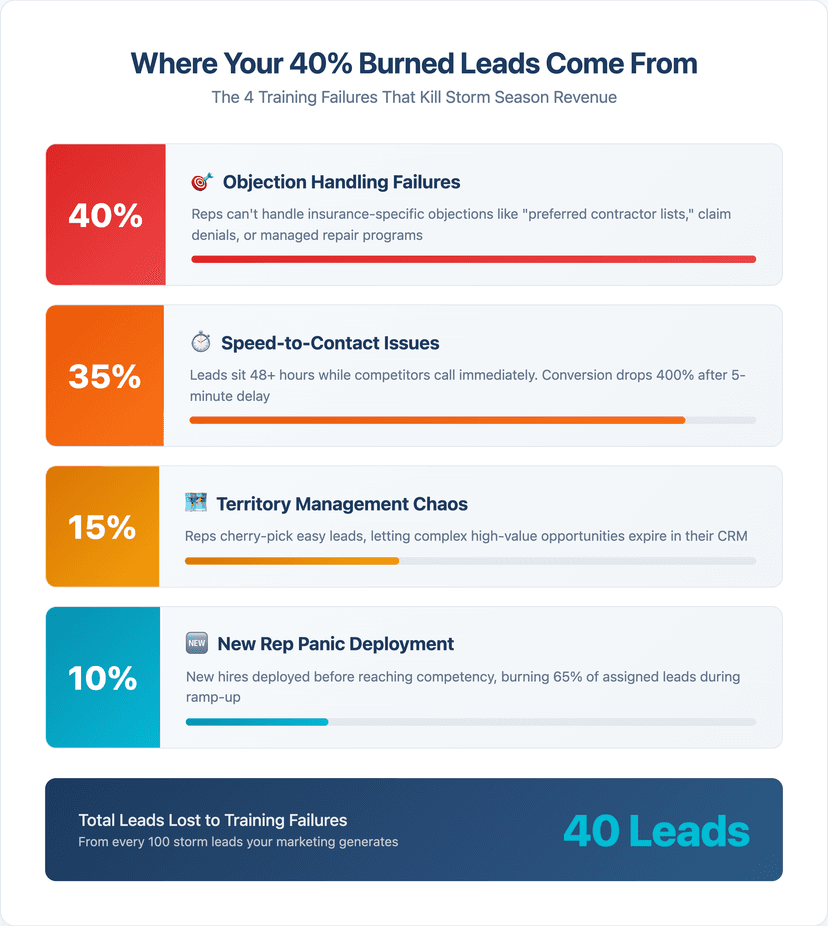
Why 40% of Storm Leads Get Burned (Calculator Breakdown)
The United Association of Storm Restoration Contractors documented how lead quality deteriorates during peak storm periods when contractors can't scale training infrastructure fast enough to match lead volume. The burned lead problem isn't about marketing effectiveness—it's about preparation gaps that become catastrophic under storm season pressure.
Speed-to-Contact Failures Cost You 35% of Burned Opportunities
Research on contractor lead response times shows conversion rates drop 400% when response time exceeds 5 minutes. Storm damaged homeowners receive contact attempts from 8-12 contractors within 72 hours. Your rep calls on day three because they were "working other leads." The homeowner already signed with the contractor who showed up on day one.
That's not a bad lead—that's a $15,000 training failure. Your rep didn't understand territory management during high-volume periods. They couldn't identify which leads required immediate response versus which could wait. They lacked the objection handling confidence to call a homeowner who just experienced storm damage and might be emotionally overwhelmed.
Objection Handling Incompetence Accounts for 40% of Burned Leads
According to GAF's storm damage assessment resources, the insurance restoration process creates objection complexity that retail roofing sales never encounters. Your reps know how to handle "I need to think about it" in standard scenarios. They have zero preparation for:
- "My insurance company's preferred contractor list doesn't include your company" (requires understanding of anti-steering laws and insurance requirements)
- "The adjuster said the damage doesn't warrant full replacement" (requires knowledge of supplementing processes and claim appeals)
- "Three contractors gave me completely different estimates ranging from $8,000 to $24,000" (requires credibility establishment around why estimates vary)
- "My managed repair program will handle this" (requires differentiation between insurance-driven programs and homeowner choice)
Bill Ragan Roofing's guide to insurance claim processes explains how even experienced reps struggle with these conversations without specific insurance objection training. Traditional role-playing with your sales manager can't create the contextual variations these objections require. Your rep needs exposure to 40+ variations of the "preferred contractor list" objection to recognize whether the homeowner is:
- Using it as a negotiating tactic (requires one response)
- Genuinely confused about their options (requires different approach)
- Testing your credibility as a contractor (requires yet another strategy)
Surface-level script memorization doesn't work. Pattern recognition through high-volume practice does.
Territory Management Chaos Wastes 15% of Opportunities
Storm season creates lead volume your team has never experienced. Your best rep gets 40 leads in a week instead of 40 per month. They can't possibly work them all effectively, so they cherry-pick the obvious opportunities and let complex situations sit in their CRM. Those complex situations—claim denials, managed repair programs, multi-contractor comparisons—represent 60% of the revenue opportunity but require 80% more objection handling sophistication.
Without systematic training on prioritization frameworks for storm leads, reps default to "first come, first served" or "whoever sounds easiest." Both approaches tank conversion rates and leave six figures on the table.
New Rep Panic Deployment Burns 10% of Leads
You hired six new reps to handle storm volume. They completed your standard training covering inspection basics and generic objection handling. Then you deployed them into the most objection-dense, time-sensitive, technically complex sales environment in residential roofing and wondered why they burned 65% of assigned leads.
The problem isn't their effort or intelligence—it's readiness measurement. Traditional training uses "hours completed" as the readiness metric. Modern training should measure "objection scenarios practiced with successful resolution." A rep who's encountered 300 varied objections with immediate feedback can reach field competency in two weeks. A rep who sat through forty hours of presentations might need six months to develop equivalent pattern recognition.
Storm Restoration Close Rate Calculator: 18% vs 35% Revenue Impact
Roofing lead conversion statistics show the industry average close rate hovers around 27%, but top storm restoration contractors achieve 32-38% while average performers close 18-23%. That 15-point gap creates massive revenue differences from identical lead volumes.
Use the calculator to test this: Keep your burned lead percentage at 40%, but increase close rate from 18% to 28%. Watch revenue increase by 40-50% from the same marketing spend generating the same lead volume.
That 10-point close rate improvement is entirely achievable through objection training—not working harder, not knocking more doors, not getting luckier with lead quality. The skill gap separating 35% closers from 18% closers breaks down to three specific competencies:
Pattern Recognition Across Objection Variations
Top performers have seen the managed repair program objection in 40+ contextual variations. They instantly recognize whether the homeowner is using it as negotiating leverage (happens 35% of the time), genuinely confused about their options (40%), or testing contractor credibility (25%). Each context requires completely different responses.
Average reps hear "managed repair program" and deploy the same response regardless of context. That response works maybe 30% of the time because it only addresses one of the three psychological contexts. Top performers read the situation, adapt their approach, and achieve 70% success rates on the same surface objection.
Insurance Process Expertise
According to Owens Corning's storm damage assessment checklist, understanding the full scope of insurance claim processes—from initial filing through supplementing to final payment—separates contractors who close at 35% from those struggling at 18%. Top performers understand that "my claim was denied" creates completely different opportunities depending on whether the denial resulted from:
- Insufficient damage documentation (easily fixable through reinspection)
- Coverage exclusions in the policy (requires different conversation about out-of-pocket options)
- Depreciation disputes (resolvable through proper appeals and RCV explanation)
- Adjuster error (common and correctable through proper documentation)
Average reps treat all denials identically and miss the 40% of denial situations that are easily resolvable through proper process knowledge.
Credibility Establishment Under Comparison Pressure
The "three contractors gave me completely different estimates" objection kills 60% of average reps but barely slows down top performers. Why? Top performers have practiced this scenario enough times to recognize it's not actually about price comparison—it's about establishing yourself as the trustworthy advisor who explains rather than the desperate closer who argues about pricing.
Case studies on roofing lead conversion document how contractors who reframe this objection around "why estimates vary and what homeowners should actually evaluate" achieve 3x higher close rates than those who immediately defend their pricing or attack competitors.
Calculate Training ROI for Storm Season Preparation
Here's the training ROI formula every roofing contractor should understand: Marketing dollars generate leads. Training effectiveness determines how many leads convert to revenue. Every dollar spent on lead generation without corresponding investment in training infrastructure represents incomplete investment strategy.
According to roofing lead cost analysis, contractors spend $45,000-$65,000 on storm season lead generation—primarily Google Ads, door knocking operations, and storm tracking services like
The calculator reveals this clearly: Plug in $55,000 marketing spend generating 400 leads. That's $137.50 per lead. Now multiply by your 40% burned lead rate: You're lighting $22,000 worth of marketing investment on fire every storm season, not counting the lost revenue from jobs you didn't close.
Traditional Training ROI Calculation
Most contractors measure training ROI backward. They calculate: "I spent $5,000 on training and hired three reps, so training cost me $1,667 per rep."
Better calculation: "My training system burned $131,400 in recoverable revenue this storm season because reps weren't prepared for objection complexity. What would I pay to recover even half of that?"
GhostRep customers typically invest $2,000-3,000 per rep for AI-powered objection training that delivers 500+ practice scenarios in the first two weeks. That seems expensive until you calculate that recovering even 20% of burned leads generates $26,280 in additional revenue from leads you already paid to generate.
Training ROI calculation: ($26,280 recovered revenue - $3,000 training cost) ÷ $3,000 = 778% ROI. And that's assuming you only recover 20% of burned leads, not the 85% reduction most GhostRep customers achieve.
Speed-to-Competency Economics
Research on roofing contractor sales training shows traditional training takes 8-12 weeks to reach basic field competency. AI-powered training compresses this to 3-4 weeks through higher-volume objection exposure and immediate feedback loops.
The economic impact: Traditional 12-week training means your new rep sits on the sideline for three months of storm season while you burn leads for lack of capacity. Modern 3-week training means that same rep becomes revenue-productive nine weeks earlier, potentially capturing 30-40 additional jobs at $15,000 each.
That's $450,000-$600,000 in additional revenue from one rep reaching competency faster. And you're worried about spending $3,000 on training?
Storm Lead Conversion Calculator: Speed-to-Contact Impact
The calculator shows how burned lead percentages directly correlate with speed-to-contact failures. Plug in 400 total leads with your current 40% burned rate. Now reduce burned leads to 28% by improving response time infrastructure. Revenue increases 18% from the same marketing spend.
According to storm damage insurance claim research, homeowners who experience storm damage operate under compressed decision timelines driven by insurance requirements, weather forecasts predicting additional storms, and emotional stress from property damage. Traditional sales timelines don't apply.
Your retail sales process might involve 3-5 touchpoints over two weeks before homeowners make decisions. Storm restoration decisions happen in 24-72 hours because:
- Insurance adjusters schedule inspections within 48 hours of claim filing
- Additional weather systems might be approaching
- Temporary repairs become permanent solutions if contractors don't respond quickly
- Competing contractors flood the territory with immediate availability
The contractor who responds within 5 minutes captures the homeowner's attention. The contractor who calls on day three gets voicemail and "we already signed with someone else" responses.
Territory Management for Speed-to-Contact
Storm season creates the territory management challenge most contractors fail to solve: How do you prioritize 40 leads received in one week when you can only physically visit 15-20 properties before homeowners make decisions?
Top performers use systematic prioritization frameworks based on:
- Damage severity indicators from initial calls (active leaking versus potential damage)
- Insurance status (claim already filed versus homeowner investigating options)
- Competitive pressure (homeowner called one contractor versus fielding multiple bids)
- Decision timeline (adjuster appointment tomorrow versus next week)
Average performers use "first come, first served" and tank their conversion rates because they waste speed-to-contact windows on low-probability opportunities while high-probability leads get burned.
NRCA resources on storm restoration emphasize how contractors who systematize lead triage during high-volume periods capture 40-50% more opportunities from identical lead volumes compared to those using ad-hoc prioritization.
New Rep Speed-to-Contact Anxiety
Here's the burned lead pattern nobody talks about: Your new reps avoid calling storm leads quickly because they're terrified of encountering objections they can't handle. They rationalize: "I'll study the territory more," "I'll research the homeowner's property," "I'll prepare my pitch better."
Meanwhile, confident competitors who've practiced 300+ objection scenarios call immediately because they trust their ability to handle whatever objection emerges. The homeowner signs with the contractor who showed up prepared and confident, not the one who showed up three days late with a "perfect pitch."
The solution isn't motivational speeches about hustle—it's systematic objection exposure until reps develop confidence through proven competency. GhostRep's AI Role Play system puts reps through 200+ varied scenarios in their first week specifically to build this confidence before they touch real leads.
Storm Season Revenue Calculator FAQs
How much revenue do roofing contractors make during storm season?
Average storm restoration contractors generate $400,000-$800,000 during peak season from 300-500 qualified leads, according to roofing industry revenue data. Top performers with close rates above 30% can exceed $1.2M from the same lead volume by reducing burned leads through superior objection handling training.
What percentage of storm leads get burned by roofing companies?
Industry research shows contractors capture only 55-62% of qualified storm leads, meaning 38-45% get burned through speed-to-contact failures, objection handling incompetence, territory management chaos, and new rep panic deployment. Storm restoration industry analysis documents how these burned leads represent training failures, not marketing ineffectiveness.
How do you calculate ROI on storm season training?
Calculate your current burned lead percentage and close rate using the revenue calculator above. Model a 15% reduction in burned leads and 5-point close rate improvement through objection training. Most contractors discover $100,000-$200,000 in recoverable revenue from leads they already generate. Compare this recoverable revenue to training investment ($2,000-$3,000 per rep) to calculate ROI, which typically exceeds 500%.
What's the average close rate for storm restoration leads?
According to roofing contractor close rate statistics, storm damage leads convert at 30-40% for top performers but only 18-23% for average contractors. The 12-17 point gap results from objection handling competency differences, not territory quality or lead generation effectiveness.
How quickly should contractors respond to storm leads?
Research on contractor response times shows conversion rates drop 400% when response time exceeds 5 minutes. Storm damaged homeowners receive contact from 8-12 contractors within 72 hours, so speed-to-contact determines who captures the opportunity. Contractors who systematize immediate response through proper training and territory management convert 40-50% more leads from identical volumes.
What causes most storm leads to get burned?
The four primary causes are: Speed-to-contact failures (35% of burned leads), objection handling incompetence at insurance-specific objections (40%), territory management chaos during high-volume periods (15%), and new rep panic deployment without adequate preparation (10%). Storm damage assessment protocols reveal these are training infrastructure failures, not lead quality issues.
How long does traditional storm season training take?
Traditional training requires 8-12 weeks to reach basic field competency through classroom presentations, ride-alongs, and limited role-playing. AI-powered training compresses this to 3-4 weeks by delivering 500+ objection scenarios with immediate feedback in the first two weeks, building pattern recognition faster than traditional methods.
What's the difference between storm leads and retail roofing leads?
Storm leads involve compressed decision timelines (24-72 hours versus 2-3 weeks), insurance process complexity, multiple contractor comparisons, managed repair programs, claim denials, and higher emotional stress from property damage. Insurance claim process documentation shows these factors create objection complexity that retail training doesn't address.
What To Do Right Now
Go back to the calculator one more time. Input your realistic storm season numbers:
- Total leads you expect this season
- Your current close rate (be honest)
- Realistic average job size for your market
- Honest assessment of burned lead percentage
Look at that "Money Left on Table" number. That's not theoretical revenue—that's actual money your current training system costs you every storm season. Money you spent marketing dollars to generate, then lost because reps weren't prepared for the objection complexity those leads created.
Now examine the "With GhostRep" projection. That improved revenue isn't from working harder, spending more on marketing, or getting lucky with better territories. It's from systematic objection training that prepares reps for the situations they'll actually encounter, delivered at the volume and variation needed to build real pattern recognition.
The question isn't whether you can afford to improve storm season training. The question is whether you can afford to keep burning 40% of the leads your marketing dollars generate.
Storm season exposes training failures you can absorb during retail periods. You can't afford those failures when lead volume spikes and every burned opportunity represents $15,000 in lost revenue plus wasted marketing investment.
The contractors who dominate storm season aren't the ones with the biggest marketing budgets—they're the ones whose training systems actually prepare reps for the objection warfare that storm restoration creates.
The calculator doesn't lie. The math is clear. Your current training approach is leaving six figures on the table every storm season. The only question is whether you'll fix it before your competitors do.
Ready to stop burning leads? Explore GhostRep's Objection Mastery for 1,000+ insurance-specific practice scenarios, or see how AI Role Play builds objection handling confidence through progressive difficulty training that compresses months of learning into weeks.
📚 Related Articles
About the Author
Tim Nussbeck
Founder & CEO of GhostRep
Two decades in roofing—knocking doors, running teams, training 1,000+ reps. Built GhostRep to give every rep access to the coaching top teams get.
The GhostRep Advantage
One Platform. Closed Loop System.
Every interaction makes your team better. AI that learns, adapts, and improves with every rep.
Hire
AI screens candidates
Train
1,000+ scenarios
Coach
Real-time guidance
Analyze
AI learns & improves
You Might Also Like
Why the Roofing Industry Got Estimating Backwards Upfront Estimating is writing your own insurance estimate before the adjuster shows up. Most roofers wait around for the insurance company to tell them what they'll pay, then spend months chasing supplements to cover what got missed. This backwards approach kills cash flow and wastes time you could spend installing roofs instead of fighting paper wars. Roofing companies have traditionally relied on supplements to compensate for underestimated c
The hailstorm rolled through your territory at 2 AM last Tuesday. By 9 AM, three out-of-state storm chasers had knocked 200 doors in your neighborhood. Your phone's been quiet. Their phones are ringing. You've built your retail roofing business over ten years. You have five crews, a solid reputation, and a steady stream of planned replacements and repairs. But when storms hit, you watch competitors pull $2.4 million in insurance work over 90 days while you're grinding out $180,000 in retail job
Hail dropped and you have zero trained reps. Traditional training takes 8 weeks. Storm leads die in 72 hours. Here's how to compress training to 3 weeks.