⏰ Every spring, roofing companies watch the same nightmare unfold. They hire five new reps in early April. By mid-May when storm season hits its stride, maybe two are actually ready to knock doors.
The other three?
Still in training, watching from the sidelines while veteran reps close deals and make money. By June, at least two of those three have quit because they've watched everyone else get paid while they sat through another PowerPoint about objection handling.
Here's the brutal math: traditional training takes eight weeks to get a rep field-ready. Storm season lasts about twelve weeks in most markets. Hire someone in early April, and they miss 📊 67% of storm season revenue sitting in training. That's not a training problem—that's a business model problem.
The 8-Week Traditional Training Timeline (And What Actually Happens)
Let's break down where those eight weeks actually go, because most owners don't realize how much time burns before a rep knocks their first door.
Week 1: Onboarding and Product Knowledge
Your new hire spends the first week learning what a ridge vent is, memorizing shingle warranties, and watching installation videos. This is necessary, but it's also the week where they're most excited and eager to start. You're teaching them about ice and water shield while they want to be making money.
Week 2: Pitch Development
Now they're learning the company pitch, practicing in conference rooms, and role-playing with other new hires who also don't know what they're doing. The sales manager splits time between five new reps, so each person gets maybe 90 minutes of actual coaching this week. The rest is watching each other stumble through pitches.
Weeks 3-4: Ride-Alongs with Veteran Reps
This is where the model starts breaking down. Your top rep—the one who should be closing deals—is now babysitting instead of selling. They do two ride-alongs per new hire, which means eight hours of lost production time per rep. Multiply that by five new hires, and your best producer just lost a full week of storm season revenue to play tour guide.
And what does the new rep actually learn? They watch someone else knock doors for four hours. They see maybe ten interactions. Half of them are "not interested" before the pitch even starts. The other half are scheduled appointments or quick measurements. They're not learning a systematic approach—they're watching someone else's natural rhythm that took years to develop.
Weeks 5-6: Supervised Knocking
Now the new rep finally gets to knock doors, but only with supervision. The sales manager drives around following five different reps through their territories, checking in on each one for an hour or two. That means each rep gets maybe eight hours of supervised knocking across two weeks—about 40-50 doors total if they're moving fast.
This is where the quality collapse happens. The rep is nervous, the manager is distracted, and nobody's getting real-time feedback. The rep develops bad habits in the 90% of doors where the manager isn't watching. By the time the manager sees it and corrects it, the habit is already set.
Weeks 7-8: "Independent" Knocking (With Daily Check-ins)
The rep is technically on their own now, but they're calling the sales manager three times a day with questions. They're still not confident. They're still not closing at a profitable rate. And they're six weeks into a twelve-week storm season.
How Much Revenue Do Roofing Companies Lose During Storm Season?
Let's be specific about what this timing costs you. According to the National Roofing Contractors Association, storm season generates the majority of roofing contractor revenue in affected markets. Storm season in most markets runs roughly April 15 through July 15—about 12-13 weeks depending on weather patterns.
If you're hiring at the start of storm season (early April) to scale up for the rush, here's what actually happens:
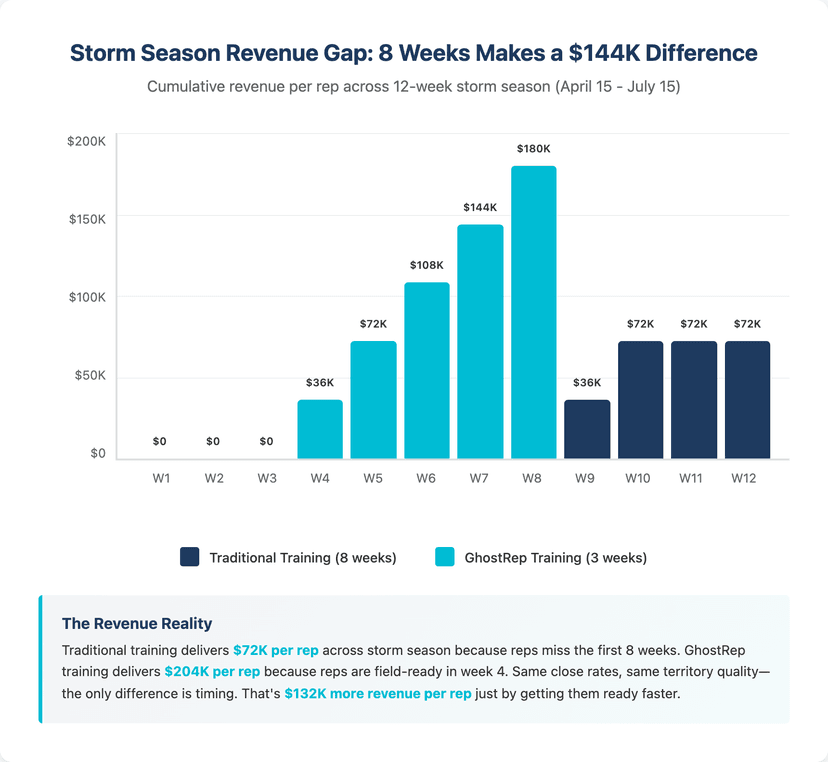
Your new rep finishes training around June 1st. That means they've missed eight weeks of prime storm season. If storm season generates 60-70% of your annual revenue (industry standard), and you've missed eight weeks of a twelve-week window, you've left massive money on the table.
Let's put real numbers on it. A productive rep in storm season should close 15-20 deals across twelve weeks—about 1.5 deals per week average. At $12,000 average job size, that's $180,000-240,000 in revenue per rep over the full season.
❌ Traditional Training Result:
Your rep misses the first eight weeks (April 15 - June 10). They're only productive for the final four weeks. Even if they hit the same close rate, they're only generating $60,000-80,000 in revenue because they missed two-thirds of the season.
💵 Revenue loss per rep: $120,000-160,000
Hire five reps? You just left $600,000-800,000 on the table because your training model can't move fast enough.
Why Do Most Companies Use Cohort Training Despite High Failure Rates?
Here's where most companies make their second mistake: they wait to hire until they have 4-5 people, then train them all at once. This seems efficient. "We'll do one training class instead of five separate ones." Except it creates three massive problems:
🔄 Problem 1: You're Batch-Processing When You Should Be Continuous
The modern recruiting approach—especially in high-turnover industries—is "always be recruiting" (A-B-R). According to Roofing Contractor's State of the Industry survey, 85% of roofing contractors struggle to hire skilled labor. You should be hiring as soon as you find good candidates, not waiting until you have enough people to justify a training class.
But if your training requires a cohort, you're forced to make good candidates wait while you find more people. By the time you've assembled your cohort, your best candidates have taken other jobs.
⚠️ Problem 2: The Staging Training Trap
Once you're locked into cohort-based training, you have to stage everything. Week 1 everyone learns product knowledge. Week 2 everyone learns the pitch. This sounds organized, but it's actually incredibly inflexible.
If someone joins mid-cohort, they're lost. If someone needs extra time on objection handling, they hold up the whole group. If your best new hire is ready to knock doors in week 3, they're sitting through two more weeks of training they don't need because the cohort isn't ready.
Nearly every company tries staging and nearly every company fails at it because markets don't wait for your training schedule. When hail hits on May 10th and you're still in "Week 4: Objection Handling," your competitors with ready reps are writing contracts while you're running role-plays.
📉 Problem 3: Your Sales Manager Can't Scale
Let's talk about what cohort training actually requires. Your sales manager needs to be present for 40 hours per week of training content across 6-8 weeks. That's 240-320 hours of direct training time. Except your sales manager also needs to manage your existing sales team, handle customer issues, attend production meetings, and deal with daily fires.
In reality, your sales manager is giving maybe 15-20 hours per week to training, splitting focus across five people. Each rep is getting 3-4 hours of actual coaching per week. The rest is them watching videos, role-playing with each other, or just sitting around waiting for the manager to be available.
When you hire your next cohort four months later, you repeat the entire process. Your sales manager burns another 240-320 hours. The model doesn't scale—it just repeats.
What Does "Always Be Recruiting" Look Like With Traditional Training?
Let me show you what A-B-R looks like in practice and why it conflicts with traditional training:
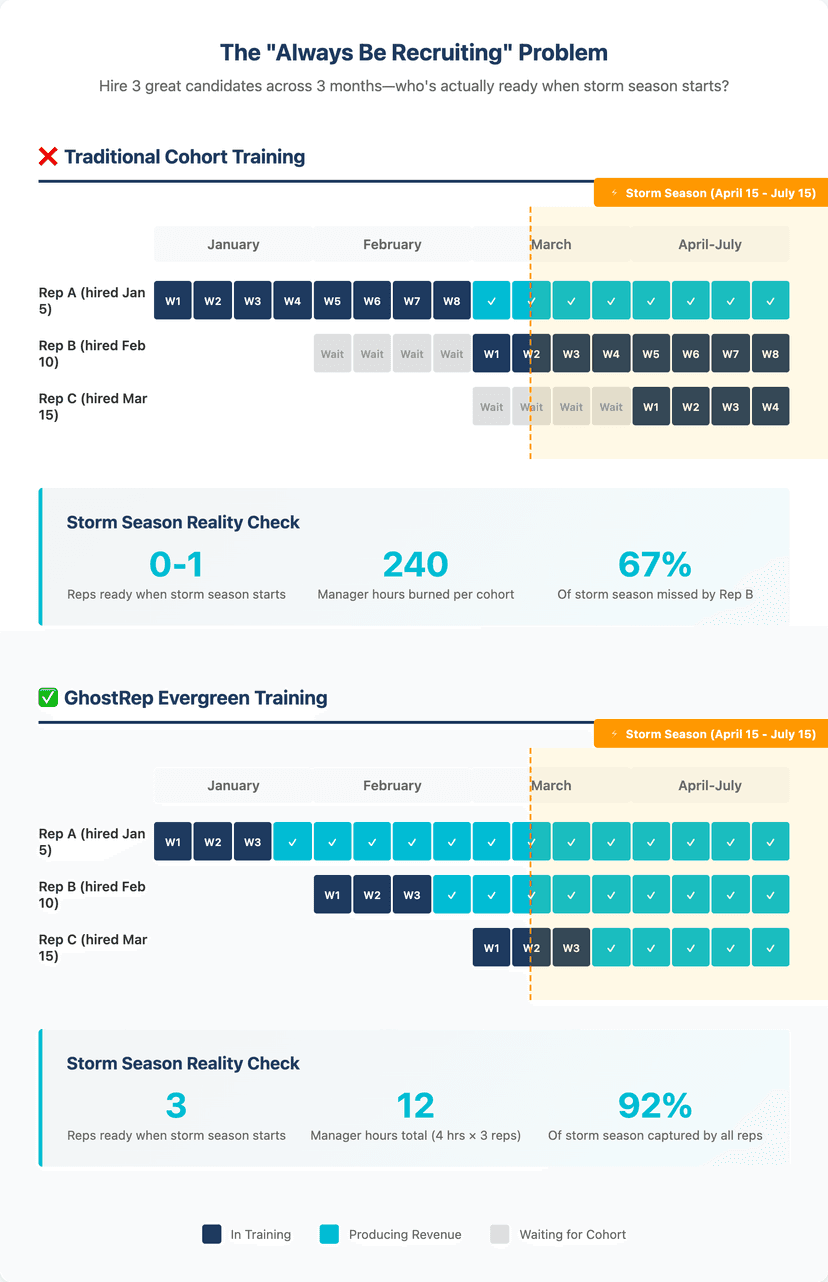
January: You hire Rep A. Great candidate, interviewed well, ready to start. You put them in an 8-week training program.
February: You hire Rep B. Another strong candidate. But Rep A is only halfway through training. Do you start Rep B on their own 8-week program (requiring your manager to run two parallel training tracks), or do you make Rep B wait three weeks so they can join Rep A's cohort midway through?
March: You hire Rep C. Now you have three options, all bad:
- Option 1: Rep C waits four weeks for Rep A to finish, then starts a new 8-week cohort alone
- Option 2: Rep C joins Rep A and B midstream, missing all the early fundamentals
- Option 3: Your manager runs three separate training tracks simultaneously (impossible)
April: Storm season starts. None of your reps are ready. Rep A is finishing week 12 of training, Rep B is on week 8, Rep C is on week 4. Your competitors who hired and trained faster are closing deals while you're still running practice pitches.
This is the staging training trap. You can't run continuous training with cohort-based methods. Every company tries. Nearly everyone fails.
What Is "Evergreen Training" and Why Does It Solve the Storm Season Problem?
Evergreen training means the content is always available and always consistent. A rep who starts on January 5th gets the exact same training quality as a rep who starts on March 20th. There's no waiting for cohorts. There's no degradation in quality when your sales manager is busy. There's no "we'll cover that next week" when a rep needs to learn something now.
Here's what evergreen looks like in practice with GhostRep:
Day 1: New rep logs in, starts the exact same training that every successful rep has completed. They're learning the pitch framework, the objection handling system, the door approach. They're practicing with AI that gives real-time feedback on every rep. They're getting through 50-100 practice doors in their first week—more than most reps see in a month of traditional training.
Week 2-3: They're still training with AI, but now they're refining. They're learning from their mistakes in a low-stakes environment. They're developing muscle memory on the pitch. They're getting comfortable with objection handling because they've heard every objection 20 times in training instead of being surprised by it at a real door.
Week 3-4: They're ready for real doors. Not "ready-ish" or "probably okay with supervision." Actually ready, meaning they've done enough reps that the pitch is automatic, they've seen enough objections that nothing surprises them, and they're confident because they've trained correctly.
How Much Does Your Sales Manager's Time Actually Cost?
One number tells the whole story: ⏰ 240 hours.
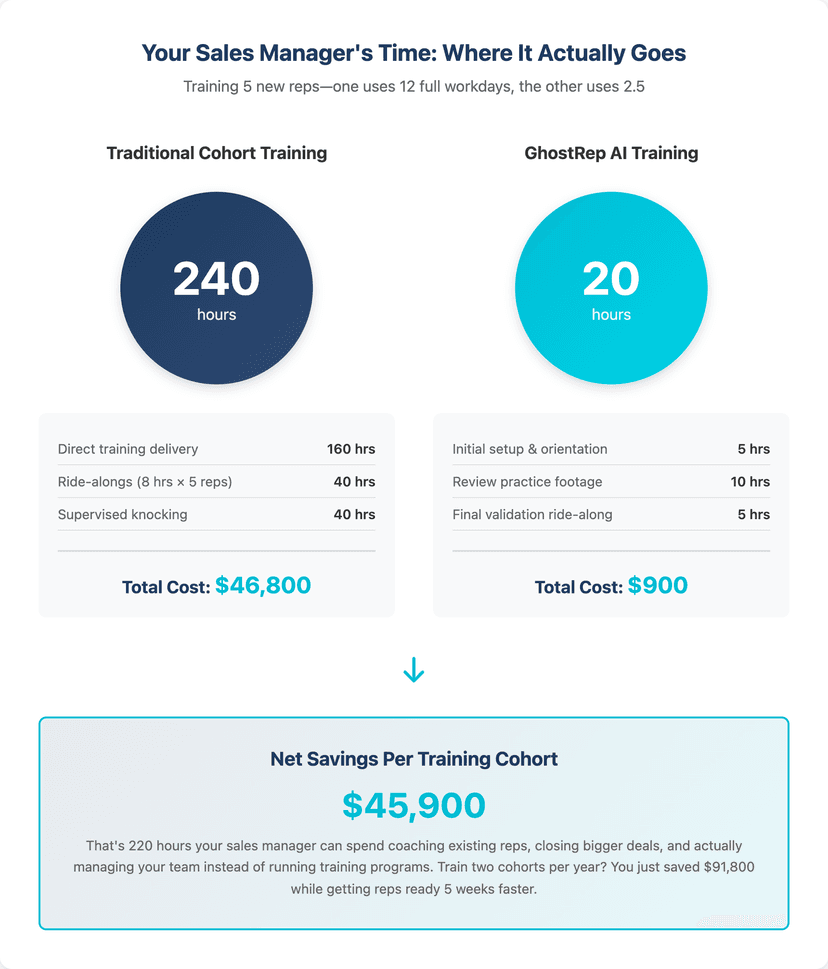
That's how much time your sales manager burns every time they train a cohort of 5 reps using traditional methods. 40 hours per week across 6 weeks of active training (being conservative—most cohort programs run 8 weeks).
Now let's talk about what that actually costs you:
💵 Direct Cost:
- Sales manager salary: $80,000-100,000/year ($40-50/hour)
- 240 hours × $45/hour = $10,800 in direct salary cost per cohort
⚠️ Opportunity Cost (The Real Number):
Your sales manager isn't just a trainer. They're supposed to be managing your existing team, coaching them through deals, helping them close bigger contracts, and making sure nobody quits mid-season. When they're locked into training mode for 6 weeks, all of that stops.
If your sales manager helps your existing team close 2 additional deals per month by being available for coaching and deal support, that's $24,000-36,000 in monthly revenue impact (2 deals × $12,000-18,000 average job). Across 6 weeks of training (1.5 months), that's $36,000-54,000 in lost revenue from reduced team performance.
🎯 Total cost per cohort: $46,800-64,800
Train two cohorts per year? That's $93,600-129,600 in annual cost just from your sales manager's time, according to Society for Human Resource Management hiring cost data.
With GhostRep's evergreen AI training, your sales manager spends 3-5 hours total per rep:
- 1 hour initial setup and orientation
- 1-2 hours checking practice footage and providing feedback
- 1-2 hours doing final validation and first ride-along
5 reps × 4 hours = 20 hours total instead of 240 hours.
What's the Real Cost Comparison Between Traditional and AI Training?
Let's run a real scenario with two companies hiring at the same time:
Company A (Traditional Training):
- Hires 5 reps on April 1
- Completes 8-week training program ending June 1
- Reps are field-ready with 4 weeks left in storm season
- Each rep closes 1.5 deals per week × 4 weeks = 6 deals per rep
- 6 deals × $12,000 average = $72,000 revenue per rep
- 5 reps × $72,000 = $360,000 total storm season revenue
- Manager time cost: $46,800
Company B (GhostRep Evergreen AI Training):
- Hires 5 reps on April 1
- Completes 3-week training ending April 22
- Reps are field-ready with 11 weeks left in storm season
- Each rep closes 1.5 deals per week × 11 weeks = 16-17 deals per rep
- 17 deals × $12,000 average = $204,000 revenue per rep
- 5 reps × $204,000 = $1,020,000 total storm season revenue
- Manager time cost: $900
🚨 Revenue difference: $660,000 💵 Cost savings: $45,900 🚀 Total impact: $705,900
That's not hypothetical. That's math based on standard close rates and standard storm season timing. Company B didn't hire better reps or have better closers. They just got their reps ready seven weeks faster, which meant they had seven extra weeks of production during the most profitable time of the year.
Common Objections to AI Training (And Real Answers)
"But won't reps feel isolated training with AI instead of in a group?"
Here's what actually happens in cohort training: Five people sit in a conference room role-playing with each other. Four of them don't know what they're doing, so they're practicing wrong. The fifth person who actually gets it is bored and waiting for everyone else to catch up. Your sales manager is splitting attention five ways, so everyone gets mediocre feedback.
With GhostRep's AI training, the rep gets 100% attention on every single rep. They practice with AI that responds realistically to their pitch. They get immediate feedback on what worked and what didn't. They do 200-300 practice doors instead of 40-60. By the time they knock their first real door, they're more confident than cohort-trained reps at week 8.
"Can AI really replicate real door situations?"
AI handles 95% of door training: pitch delivery, objection handling, tonality, pacing, reading homeowner responses, and adapting in real-time. The 5% it doesn't handle—actual human unpredictability, weather conditions, neighborhood dynamics—that's what the first week of real knocking is for.
But here's what cohort training doesn't replicate either: Any of it. Your reps practice with other new reps who don't know what they're doing, then ride along with veterans watching instead of doing. They're getting maybe 40-60 practice reps before real doors. AI gives them 200-300 practice reps with realistic responses and real-time feedback.
"What if storm season starts early and we need people ready NOW?"
That's exactly when evergreen AI training matters most. Traditional training can't speed up—your sales manager still needs 8 weeks to run through the curriculum. AI training can compress to 2-3 weeks if you need emergency speed because the rep can train 60-80 hours in those weeks instead of 20-30.
When hail hits unexpectedly in late March and you need 5 more reps field-ready by April 15, traditional training can't deliver. GhostRep training can.
"We've always done cohort training and it works fine."
Define "fine." According to construction industry turnover data from the National Association of Home Builders, construction firms see turnover rates exceeding 60% in the first year, with roofing specifically experiencing average employee tenure of just 16 months.
If by "fine" you mean "3 out of 5 reps quit within 90 days," then yes, it works fine. If by "fine" you mean "we miss the first 6-8 weeks of storm season every year," then yes, it works fine.
The real question: How much revenue are you leaving on the table because your training model can't move as fast as your business needs to?
"Isn't AI training just cheaper, not better?"
AI training is both cheaper AND better. It's cheaper because your sales manager isn't locked into training mode for 240 hours per cohort. It's better because reps get 200-300 practice doors instead of 40-60, they get consistent training regardless of when they start, and they're field-ready in 3-4 weeks instead of 8.
The cost savings are a bonus. The real value is getting productive reps into the field 4-5 weeks faster, which means they're making money during storm season instead of sitting through PowerPoints.
"How do we know if AI training actually works?"
Track two metrics:
- Time to first deal (how many days from hire date to first closed contract)
- 90-day retention rate (how many reps are still productive after 90 days)
Traditional training: 60-75 days to first deal, 40-60% retention GhostRep AI training: 30-45 days to first deal, 60-80% retention
The data doesn't lie. Reps who get ready faster and start making money faster stick around longer.
Frequently Asked Questions About Roofing Sales Training
How long does it take to train a new roofing sales rep?
Traditional training takes 8 weeks to get reps field-ready through cohort-based programs with classroom instruction, ride-alongs, and supervised knocking. AI-powered training with GhostRep compresses this to 3-4 weeks by providing 200-300 practice scenarios instead of 40-60 supervised doors, allowing reps to develop muscle memory and confidence faster.
What percentage of roofing revenue comes from storm season?
Storm season typically generates 60-70% of annual revenue for roofing contractors affected by severe weather events. The primary storm season window runs approximately 12-13 weeks from mid-April through mid-July in most U.S. markets, with regional variations based on weather patterns.
How much does traditional sales training cost roofing companies?
Between direct salary costs ($10,800 per cohort) and opportunity cost from lost manager availability ($36,000-54,000 per cohort), traditional cohort training costs $46,800-64,800 per group of 5 reps. This doesn't include the revenue lost from reps sitting in training instead of selling during peak season.
Can AI training really prepare reps faster than traditional methods?
Yes. Reps complete 200-300 practice doors with AI feedback in 3-4 weeks versus 40-60 supervised doors in 8 weeks with traditional training. The increased repetition builds muscle memory faster, exposes reps to more objection scenarios, and creates confidence through actual practice rather than passive observation during ride-alongs.
Why do roofing sales reps quit in the first year?
Construction industry turnover exceeds 60% in the first year according to NAHB data, with roofing reps showing average tenure of just 16 months. The primary causes include insufficient training before field deployment, lack of early success leading to discouragement, and the gap between when reps start training and when they start making money—especially critical when training delays extend through peak earning seasons.
The Bottom Line on Training Timing
Traditional training takes 8 weeks. Storm season lasts 12 weeks. If you hire at the start of storm season to scale up for demand, your reps miss 67% of storm season sitting in training while your competitors' ready reps are closing deals and making money.
The solution isn't to train faster with worse quality. The solution is evergreen AI training that gets reps actually ready in 3-4 weeks with 200-300 practice doors instead of 8 weeks with 40-60 practice doors.
The math is simple:
❌ Traditional: Hire 5 reps, 2-3 survive, $360K storm season revenue, $46,800 training cost per cohort
✅ GhostRep Evergreen AI: Hire 5 reps, 4 survive, $1,020,000 storm season revenue, $900 training cost total
💰 Revenue difference: $660,000 💵 Cost savings: $45,900 🚀 Total impact: $705,900
The question isn't whether AI training works better. The question is how much longer you're willing to leave $700K on the table every storm season because your training model was built for a different era.
Ready to see how GhostRep's AI-powered training platform can get your reps field-ready in 3-4 weeks instead of 8? Check out our AI Role Play system that provides 1,000+ practice scenarios, our Objection Mastery program that covers every door situation your reps will encounter, and our Ghost Rep real-time coaching that whispers the right response during actual appointments.
About the Author
Tim Nussbeck
Founder & CEO of GhostRep
Two decades in roofing—knocking doors, running teams, training 1,000+ reps. Built GhostRep to give every rep access to the coaching top teams get.
The GhostRep Advantage
One Platform. Closed Loop System.
Every interaction makes your team better. AI that learns, adapts, and improves with every rep.
Hire
AI screens candidates
Train
1,000+ scenarios
Coach
Real-time guidance
Analyze
AI learns & improves
You Might Also Like
Why the Roofing Industry Got Estimating Backwards Upfront Estimating is writing your own insurance estimate before the adjuster shows up. Most roofers wait around for the insurance company to tell them what they'll pay, then spend months chasing supplements to cover what got missed. This backwards approach kills cash flow and wastes time you could spend installing roofs instead of fighting paper wars. Roofing companies have traditionally relied on supplements to compensate for underestimated c
The hailstorm rolled through your territory at 2 AM last Tuesday. By 9 AM, three out-of-state storm chasers had knocked 200 doors in your neighborhood. Your phone's been quiet. Their phones are ringing. You've built your retail roofing business over ten years. You have five crews, a solid reputation, and a steady stream of planned replacements and repairs. But when storms hit, you watch competitors pull $2.4 million in insurance work over 90 days while you're grinding out $180,000 in retail job
Hail dropped and you have zero trained reps. Traditional training takes 8 weeks. Storm leads die in 72 hours. Here's how to compress training to 3 weeks.